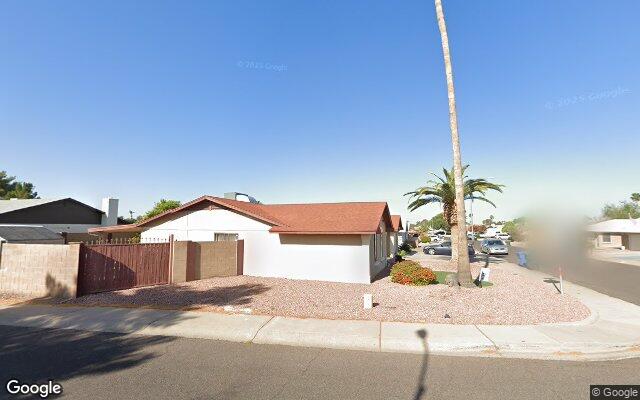
Villa Hermosa Assisted Living.

A medium home, reviewed on public record.
© Google Street View
Compared to 1,661 Arizona facilities with a similar number of beds.
Care · 36-month window. Higher percentile = better performance on inspection record. Source: Arizona Dept. of Health Services · Bureau of Residential Facilities Licensing.
among peers to rank.
Rankings based on 36-month ADHS inspection data. Severity and frequency: fewer citations = higher percentile. Repeat rate: lower repeat citation share = higher percentile.
Citation history, plotted month by month.
21 deficiencies on record. Each bar is a month with a citation.
Finding distribution
21 total · 36 monthsScope × Severity (CMS A–L)
Every inspection visit, verbatim.
2 inspections in the public record, most recent first. Plain-language summaries open first — click into any row for the full citation text.
2026-04-23Complaint InvestigationEnforcement · 15 findings
“Based on record review, documentation review, and interview, the health care institution failed to implement tuberculosis (TB) infection control activities, which included annually assessing the health care institution's risk of exposure to infectious tuberculosis. The deficient practice posed a potential TB exposure risk to residents. Findings include: 1. A review of the facility’s documentation revealed no annual assessment of the facility's TB risk assessment. 2. In an interview, E4 acknowledged that an assessment of the health care institution's risk of exposure to infectious TB was not conducted. 3. In an exit interview, the findings were reviewed with E4, and no additional information was provided.”
“Based on documentation review, record review, and interview, the manager failed to ensure employees provided documentation of freedom from infectious tuberculosis (TB) as specified in R9-10-113 for one of three employees sampled. The deficient practice posed a potential TB exposure risk to residents. Findings include: 1. R9-10-113.A states, "If a health care institution is subject to the requirements of this Section, as specified in an Article in this Chapter, the health care institution's chief administrative officer shall ensure that the health care institution establishes, documents, and implements tuberculosis infection control activities that...2. Include: a. For each individual who is employed by the health care institution, provides volunteer services for the health care institution, or is admitted to the health care institution and who is subject to the requirements of this Section, screening, on or before the date specified in the applicable Article of this Chapter, that consists of: i. Assessing risks of prior exposure to infectious tuberculosis, ii. Determining if the individual has signs or symptoms of tuberculosis, and iii. Obtaining documentation of the individual's freedom from infectious tuberculosis according to subsection (B)(1)..." 2. A review of the Centers for Disease Control and Prevention website revealed a web page titled "TB Screening and Testing of Health Care Personnel." The web page stated, "If the Mantoux tuberculin skin test (TST) or Interferon Gamma Release Assay (IGRA) test is used to test health care personnel upon hire (preplacement), two-step testing should be used." 3. A review of E1’s personnel record revealed the following: E1’s hire date of September 4, 2025; One negative TB skin test, more than 12 months old; One negative TB skin test, without documentation of a date or time the results were collected; and Documentation of E1's risk of prior exposure to TB and freedom from the signs and symptoms of TB. However, the documentation was not signed or dated. 4. In an exit interview, the findings were reviewed with E4, and no additional information was provided. 5. Technical assistance was provided regarding this rule during the compliance inspection conducted on February 13, 2024.”
“Based on record review, documentation review, and interview, the manager failed to ensure that, before providing assisted living services to a resident, a caregiver provided current cardiopulmonary resuscitation (CPR) training specific to adults, for two of three personnel sampled. The deficient practice posed a risk if an employee was unable to meet a resident's needs during an emergency. Findings include: 1. A review of E2's personnel record revealed a certificate of completion for CPR and Automated External Defibrillator (AED) from the American CPR Care Association with an expiration date of April 6, 2028. 2. A review of E3's personnel record revealed a certificate of completion for CPR and Automated External Defibrillator (AED) from the American CPR Care Association with an expiration date of January 25, 2027. 3. A review of the facility’s personnel schedule for April 2026 revealed the following: E2 worked Saturday to Wednesday in the evening; and E3 worked Saturday to Wednesday in the morning. 4. A review of the facility’s policies and procedures revealed a policy titled “First Aid and CPR Training.” The policy stated, “Each employee or volunteer will demonstrate and perform CPR by going through the motion of performing cardio pulmonary resuscitation, if the training is through a different training organization other than the National Safety Council, American Heart Association, or American Red Cross. The qualified individual verifying and document the skills demonstration needs to have a qualification to perform verification, such as a CPR instructor. Employees unable to properly demonstrate will not be hired until he/she is able to perform CPR.” 5. A review of American CPR Care Association website revealed “American CPR Care Association provides training in online CPR certification, AED training and Standard First Aid for lay-responders and Healthcare Providers.” 6. In an exit interview, the findings were reviewed with E4, and no additional information was provided.”
“Based on documentation review, record review, and interview, the manager failed to ensure that a resident provided evidence of freedom from infectious tuberculosis (TB) before or within seven calendar days after the resident's date of occupancy and as specified in R9-10-113, for one of two residents sampled. The deficient practice posed a potential TB exposure risk to residents. Findings include: 1. R9-10-113.A states, "If a health care institution is subject to the requirements of this Section, as specified in an Article in this Chapter, the health care institution's chief administrative officer shall ensure that the health care institution establishes, documents, and implements tuberculosis infection control activities that...2. Include: a. For each individual who is employed by the health care institution, provides volunteer services for the health care institution, or is admitted to the health care institution and who is subject to the requirements of this Section, screening, on or before the date specified in the applicable Article of this Chapter, that consists of: i. Assessing risks of prior exposure to infectious tuberculosis, ii. Determining if the individual has signs or symptoms of tuberculosis, and iii. Obtaining documentation of the individual's freedom from infectious tuberculosis according to subsection (B)(1)..." 2. A review of R3's medical record revealed the following: No documentation of R3's freedom from infectious TB; and No documentation of R3's freedom from the signs and symptoms of infectious TB; and No documentation of R3's risks of prior exposure to TB. Based on R3's admission date, this documentation was required. 3. In an exit interview, the findings were reviewed with E4, and no additional information was provided.”
“Based on record review and interview, the manager failed to ensure that before or at the time of acceptance, an individual submitted documentation that was dated within 90 calendar days before the resident was accepted by the assisted living facility which included if an individual was requesting or was expected to receive supervisory care services, personal care services, or directed care services, whether the individual required continuous medical services, continuous or intermittent nursing services, restraints; and was dated and signed by a physician, registered nurse practitioner, registered nurse, or physician assistant for one of three residents sampled. The deficient practice posed a risk if the facility was unable to meet a resident's needs. Findings include: 1. A review of R3’s medical record revealed documentation with the required elements dated within 90 days of R3's acceptance; however, the documentation was not signed by a medical practitioner or registered nurse as required. 2. In an exit interview, the findings were reviewed with E4, and no additional information was provided.”
“Based on record review and interview, the manager failed to ensure that a resident had a service plan that documented the level of service the resident was expected to receive for one of three residents sampled. The deficient practice posed a risk as the service plan did not reinforce and clarify the services to be provided to a resident. Findings include: 1. A.R.S. 36-401 stated, “Personal care services means assistance with activities of daily living that can be performed by persons without professional skills or professional training and includes the coordination or provision of intermittent nursing services and the administration of medications and treatments by a nurse who is licensed pursuant to title 32, chapter 15 or as otherwise provided by law.” 2. A review of R2’s medical record revealed a current service plan dated July 30, 2025, which indicated that R2 received supervisory care services. However, the service plan indicated that R2 receives medication administration from the facility. 3. In an interview, E4 reported that R2 is independent with all activities of daily living, the facility manages all of R2’s medication, and administers the medication. 4. In an exit interview, the findings were reviewed with E4, and no additional information was provided.”
“Based on record review and interview, the manager failed to ensure a resident's written service plan included the amount, type, and frequency of assisted living services provided to the resident, for teo of three residents sampled. The deficient practice posed a risk as the service plans did not reinforce and clarify the services to be provided to a resident. Findings include: 1. A review of R1's medical record revealed a current written service plan dated November 3, 2025, which indicated R1 received personal care services. R1’s service plan did not include the frequency of toileting, transfer, and medication management. 2. A review of R3's medical record revealed a current written service plan dated April 9, 2026, which indicated R3 received personal care services and required assistance with all activities of daily living. R3’s service plan did not include the frequency of oral care, hair care, personal hygiene, dressing, eating, laundry, toileting, positioning, transferring, ambulation, and medication management. 3. In an exit interview, the findings were reviewed with E4, and no additional information was provided.”
“Based on record review and interview, the manager failed to ensure a written service plan was updated no later than 14 days after a significant change in a resident's physical, cognitive, or functional condition, for one of three residents sampled. The deficient practice posed a health and safety risk to the resident if the service plan did not accurately depict the resident's needs. Findings include: 1. A review of R1's medical record revealed a service plan dated November 3, 2025. The service plan indicated R1 received personal care services and was incontinent. 2. A review of R1’s medical record revealed a document titled “Activity of Daily Living” with no date. The document indicated that R1 received catheter care. However, the service plan did not indicate that R1 had a catheter. 3. In an interview, E4 reported that R1 had a catheter placed in January 2026. 4. In an exit interview, the findings were reviewed with E4, and no additional information was provided.”
“Based on record review, documentation review, and interview, the manager failed to ensure a caregiver or an assistant caregiver documented the services provided to a resident in the resident's medical record for one of three sampled residents. The deficient practice posed a risk as services could not be verified as provided against a service plan, and the Department was provided false or misleading information. Findings include: 1. Upon arrival at the facility, the Compliance Officers were greeted by E1. Once the Compliance Officers sat in the kitchen, E1 went to the back of the house. E3 came from the back of the house to greet the Compliance officers. 2. During the environment inspection with E3, the Compliance Officers observed R3 sitting on the patio by R3’s self and without any caregivers. 3. A review of R3’s medical record revealed a current service plan dated April 8, 2026. The service plan indicated that R3 receives assistance with all activities of daily living (ADL), medication administration, and “outside safety - direct supervision - staff remain with resident at all times outside.” 4. A review of the facility’s documentation revealed a document titled “Resident Admission & Care Coordination Report” dated April 6, 2026. The report stated the following: “R3 was admitted as an emergency transfer due to the closure of the previous assisted living facility. No Power of Attorney (POA) was present at the time of admission. Placement was coordinated through a referral source due to urgent need for housing and care.” “Medical & Medication issues: Previous facility provided only two medications upon transfer. A Medication Administration Record (MAR) was provided; however MAR is incomplete and not properly signed. No physician-signed medication list available.” “Family reported that resident is under the care of a mobile doctor, but: no contact information was initially provided. Medication refills are pending due to lack of provider coordination.” “Follow-up on Medical Provider: Family indentified Amalia (Nurse Practitioner) from a mobile group. Appointment was scheduled for April 19, 2026. Provider did not show up for scheduled visit. Management notified the family and is awaiting rescheduling confirmation.” 5. A review of R3’s medical records revealed a current service plan dated April 8, 2026 and signed by a medical practitioner, resident representative, and the manager. 6. In an interview, E4 reported that R3 has only had two meds since R3 moved in. E4 reported that the facility has been trying to get a mobile doctor for R3. E4 reported that R3 had an appointment on April 20, 2026. However, there was still no signed med list nor new prescriptions for R3’s medication. 7. In an exit interview, the findings were reviewed with E4, and no additional information was provided.”
“Based on record review and interview, the manager failed to ensure that a resident's medical record contained a medication order from a medical practitioner for each medication that was administered to the resident, for one of three residents sampled. The deficient practice posed a risk as the medication administered could not be verified against a medication order. Findings Include: 1. A review of R3’s medical record revealed a current service plan dated April 6, 2026, which indicated that R3 received medication administration. 2. A review of R3’s medication administration record (MAR) for April 2026 revealed that R3 was administered “Aspirin 81 mg” and “Keppra 750 mg” from April 6, 2026, to April 23, 2026. 3. A review of R3’s medical record revealed no signed medication orders for “Aspirin 81 mg” and “Keppra 750 mg.” 4. In an interview, E4 reported that “Aspirin 81 mg” and “Keppra 750 mg” were administered without a signed medication order. 5. In an exit interview, the findings were reviewed with E4, and no additional information was provided.”
“Based on record review and interview, the manager failed to ensure the service plan for a resident receiving personal care services included skin maintenance to prevent and treat bruises, injuries, pressure sores, and infections, offering sufficient fluids to maintain hydration, and incontinence care that ensured a resident maintained the highest practicable level of independence when toileting, for one of three residents sampled. Findings include: 1. A review of R3’s medical record revealed a current service plan dated April 8, 2026, which indicated that R3 was receiving personal care services. However, the service plan did not include skin maintenance to prevent and treat bruises, injuries, pressure sores, and infections, offering sufficient fluids to maintain hydration, and incontinence care that ensured a resident maintained the highest practicable level of independence when toileting. 2. A review of R3's medical record revealed a document titled "Activity Daily Living" for April 2026. The "Activity Daily Living" revealed that R3 received "skin condition," "incontinence care," and "fluid intake." 3. In an exit interview, the findings were reviewed with E4, and no additional information was provided.”
“Based on observation, documentation review, and interview, the manager failed to ensure medication was stored in a separate locked room, closet, cabinet, or self-contained unit used only for medication storage. The deficient practice posed a risk to residents who were unable to self-administer medications. Findings include: 1. During the environmental inspection of the facility, accompanied by E3, the Compliance Officers observed an unlocked refrigerator with a locked medication storage box inside. Prescribed medication, including semaglutide injections and KwikPen insulin injections, were left outside the locked box inside the refrigerator. 2. Upon documentation review, the facility’s policies and procedures titled “Part II Receiving, Storing Medication” stated, “Medications that need refrigeration will be stored in a locked box, in the facility refrigerator or in a separate locked refrigerator dedicated only for medication storage”. 3. In an exit interview, the findings were discussed with E4, and no additional information was provided.”
“Based on observation, documentation review, and interview, the manager failed to ensure policies and procedures were implemented for storing medication. The deficient practice posed a risk as the standards expected of employees were not followed. Findings include: 1. During the inspection of the facility, the Compliance Officers observed the same set of keys unattended twice in two different locations: the kitchen counter and next to a work laptop. 2. During the environmental inspection of the facility, accompanied by E3, the Compliance Officers observed several other keys (card keys, a magnetic key, and physical security keys) in an unlocked drawer located in the hallway office area of the facility. 3. Upon further environmental inspection, the Compliance Officers requested E3 to open the locked cabinets surrounding the office area and the locked storage wardrobe down the hall using the card key and physical security keys labeled “NARC KEY” and “MED KEY”. The card key opened one of the upper office cabinets, and the “NARC KEY” opened the locked medication box inside the cabinet. The “MED KEY” opened the storage wardrobe down the hall. The Compliance Officers were able to access prescription medications. 4. Upon documentation review of the facility’s policies and procedures, the section titled “Part II Receiving, Storing Medication” stated, “Only the Manager and trained Caregivers shall be in possession of the keys to the medication storage area". 5. In an exit interview, the findings were discussed with E4, and no additional information was provided.”
“Based on documentation review and interview, the manager failed to ensure that an employee disaster drill was conducted on each shift at least once every three months and documented. The deficient practice posed a risk if employees were unable to implement the disaster plan. Findings include: 1. A review of the facility's disaster drill documentation revealed documentation of a disaster drill conducted on November 16, 2025, for the day and evening shift. However, documentation of additional drills was not available for review. 2. A review of the facility's personnel schedule for March 2026 revealed that there were morning and evening shifts. 3. In an exit interview, the findings were reviewed with E4, and no additional information was provided.”
“Based on observation, documentation review, and interview, the manager failed to ensure poisonous or toxic materials stored by the assisted living facility were maintained in a locked area separate from food preparation and storage, dining areas, and medications, and were inaccessible to residents. The deficient practice posed a risk to the physical health and safety of a resident. Findings include: 1. During the environmental inspection of the facility, accompanied by E3, the Compliance Officers observed a cabinet underneath the kitchen sink. One door of the cabinet was locked while the other was unlocked, and the Compliance Officers were able to access the following chemicals: Lysol disinfectant spray; Febreze; Dawn dish soap; Hot Shot insect killer spray; The Pink Stuff cleaner; Cascade dishwashing pods; and Clorox disinfecting wipes. 2. Upon documentation review, the facility’s policies and procedures section titled “Environmental and Physical Plant Safety, includes Pest Control Program” stated, “Poisonous and toxic materials will be in labeled containers and stored in a locked area separate from food preparation and food storage areas, dining areas, and medications and are inaccessible to residents." 3. In an exit interview, the findings were discussed with E4, and no additional information was provided.”
2024-02-13Annual Compliance VisitA.A.C. · 6 findings
“Based on documentation review, record review, and interview, the manager failed to ensure the health care institution developed and administered a training program for all staff regarding fall prevention and fall recovery that included initial training and continued competency training. The deficient practice posed a risk to the physical health and safety of a resident. Findings include: 1. Review of facility documentation revealed a policy and procedure titled "Fall Prevention and Recovery Training" that stated "...The training program requires initial training and continued competency review on an annual basis in fall prevention and fall recovery..." 2. Review of E1's personnel record revealed E1 worked as a caregiver and had a hire date of January 1, 2023. The personnel record revealed documentation of fall prevention training dated January 1, 2023. However, current documentation was not available indicating E1 completed fall prevention and fall recovery training. 3. Review of E2's personnel record revealed E2 worked as a caregiver and had a hire date of January 1, 2023. The personnel record revealed documentation of fall prevention training dated January 1, 2023. However, current documentation was not available indicating E2 completed fall prevention and fall recovery training. 4. Review of E4's personnel record revealed E4 worked as an assistant caregiver and had a hire date of January 29, 2024. The personnel record did not include documentation that showed E4 completed fall prevention and fall recovery training. 5. Review of E5's personnel record revealed E5 worked as a manager and had a hire date of March 18, 2021. The personnel record revealed documentation of fall prevention training dated January 20, 2022. However, current documentation was not available indicating E5 completed fall prevention and fall recovery training. 6. In an interview, E1 and E2 acknowledged documentation was not available that showed E1, E2, E4, and E5 had completed initial training and continued competency training for fall prevention and fall recovery.”
“Based on documentation review, record review, and interview, the manager failed to ensure a resident medical record contained documentation of notification of the resident of the availability of vaccination for influenza (flu) and pneumonia, according to A.R.S. \'a7 36-406(1)(d), to one of one resident reviewed. The deficient practice posed a potential illness risk to residents. Findings include: 1. A.R.S. \'a7 36-406(1)(d) states "The department shall: Require as a condition of licensure that nursing care institutions and assisted living facilities make vaccinations for influenza and pneumonia available to residents on site on a yearly basis. The department shall prescribe the manner by which the institutions and facilities shall document compliance with this subdivision, including documenting residents who refuse to be immunized. The department shall not impose a violation on a licensee for not making a vaccination available if there is a shortage of that vaccination in this state as determined by the director." 2. Review of R2's medical record revealed R2 refused the flu and pneumonia vaccinations July 15, 2022. However, current documentation was not available that showed the flu and pneumonia vaccinations were offered or received. Based on R2's acceptance date, this documentation was required. 3. In an interview, E1 and E2 acknowledged R2's medical record did not include current documentation that showed the flu and pneumonia vaccinations were offered or received.”
“Based on record review and interview, the manager failed to ensure the facility did not accept or retain a resident who was confined to a bed or chair because of an inability to ambulate even with assistance, unless the facility obtained a written determination from a medical practitioner, every six months, that stated the resident's needs could be met by the facility and the resident's needs were within the facility's scope of services, for one of two residents reviewed who were confined to a bed or chair. The deficient practice posed a risk if the facility was unable to meet a resident's needs. Findings include: 1. Review of R2's medical record revealed a current written service plan for directed care services dated February 1, 2024. This service plan stated "Patient is bedbound". 2. Review of R2's medical record revealed a written determination from R2's medical practitioner signed and dated October 25, 2022. However, documentation was not available that stated R2's needs could be met by the facility and R2's needs were within the facility's scope of services, at least once every six months. 3. In an interview, E1 reported R2 was unable to ambulate even with assistance since at least January 2023 and E1 and E2 acknowledged R2's medical practitioner did not provide a written determination at least once every six months.”
“Based on record review, observation, and interview, the manager failed to ensure a medication was administered in compliance with a medication order, for one of two residents reviewed. The deficient practice posed a risk if the resident experienced a change in condition due to improper administration of medication. Findings include: 1. Review of R1's medical record revealed a current written service plan dated December 18, 2023. This service plan indicated R1 received medication administration. 2. Review of R1's medical record revealed signed medication orders dated February 5, 2024. These medication orders stated the following: "HumaLog KwikPen Subcutaneous Solution Pen-Injector 100 Unit/ml sig: inject 15 units before lunch and dinner BID hold if BS is”
“Based on record review, observation, and interview, the manager failed to ensure a medication administered to a resident was documented in the resident's medical record, for one of two residents reviewed. The deficient practice posed a risk as medication could not be verified as administered against a medication order. Findings include: 1. Review of R1's medical record revealed a current written service plan dated December 18, 2023. This service plan indicated R1 received medication administration. 2. Review of R1's medical record revealed a signed medication order dated February 5, 2024. This medication order stated "Calmoseptine Oint 0.44-20.6% sig: Apply topically to the groin after each diaper change. Keep clean and dry". 3. Review of R1's medical record revealed a February 2024 medication administration record (MAR). This MAR stated "Calmoseptine ointment Apply topically to groin @ diaper changes PRN" and did not indicate this medication was administered February 1st - present. 4. During an observation of R1's medications, Calmoseptine was observed. 5. In an interview, E3 reported Calmoseptine was administered per the medication order. E1 and E2 acknowledged R1's medical record did not include documentation the medication was administered.”
“Based on documentation review and interview, the manager failed to ensure the facility's disaster plan was reviewed at least once every 12 months. The deficient practice posed a risk as a disaster plan reinforces and clarifies standards expected of employees. Findings include: 1. Review of the facility's policy and procedure revealed a policy titled "Disaster plan, Relocation, Records, Medication, Food and Water." However, the most recent available documentation showed the disaster plan was last reviewed June 25, 2022. 2. In an interview, E1 and E2 acknowledged the facility's disaster plan was not reviewed at least once every 12 months.”
Other facilities in Glendale.
Other memory care facilities near Glendale with similar care offerings.

Tour Prep
Family reviews
No reviews yet — be the first to share your experience