Springbrooke Senior Living
9 CDPHE citations on record, last inspected Feb 2026, license 2304I0.
Springbrooke Senior Living has 9 CDPHE citations on record; last inspected Feb 2026.
Memory-care basis not yet recorded from the state file.
Source: Colorado Department of Public Health and Environment
CDPHE recordLast inspection February 3, 2026
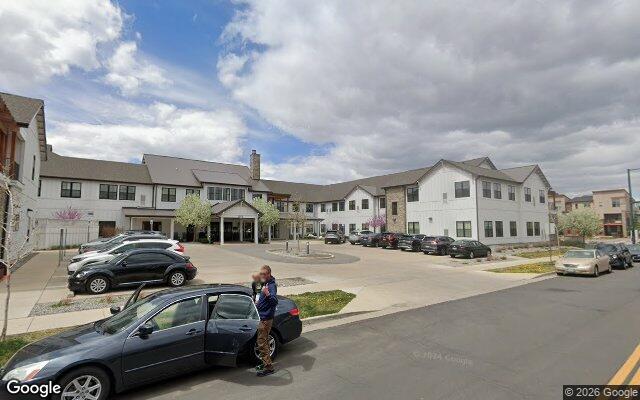
A large home, reviewed on public record.

© Google Street View
Compared to 25 Colorado facilities with a similar number of beds.
Assisted living memory care · 36-month window. Higher percentile = better performance on inspection record. Source: Colorado Department of Public Health and Environment.
on file.
among peers to rank.
Rankings based on 36-month CDPHE inspection data. Severity and frequency: fewer citations = higher percentile. Repeat rate: lower repeat citation share = higher percentile.
Citation history, plotted month by month.
9 deficiencies on record. Each bar is a month with a citation.
Finding distribution
9 total · 36 monthsCDPHE Level A–E
The rules that apply to this facility.
State requirements with the exact regulation citation, plain-language explanation, and a question to ask on tour. Rules this facility has been cited for appear first.
Plain language
CDPHE licenses assisted living residences. A secure environment for residents who need one is optional under Chapter 7, Part 25. CDPHE does not publish a facility-level list of homes that have that option, so this page does not call the home state-verified memory care.
Ask on tour
“Ask whether the home has a secure environment, and ask to see the part of the license that says so.”
Questions to ask before you visit.
A short pre-tour checklist tailored to Springbrooke Senior Living's record and state requirements.
CDPHE records show 12 deficiencies across 7 inspection reports, with 1 serious citation — can you walk us through the corrective action plan for that serious deficiency and show documentation that it has been resolved?
Ask the operator on tour. Take notes and compare answers across facilities you visit.
Five complaints were filed with CDPHE during the inspection period on file — were any of those complaints substantiated, and what specific changes did the facility make in response?
Ask the operator on tour. Take notes and compare answers across facilities you visit.
The most recent state inspection was conducted on May 13, 2025 — can you provide a copy of that inspection report and any follow-up correspondence from CDPHE confirming that all cited deficiencies have been corrected?
Ask the operator on tour. Take notes and compare answers across facilities you visit.
From this home's file.
Counts and lines from the state file we hold.
- Does Springbrooke Senior Living provide memory care?
Memory-care basis not yet recorded from the state file.
- When was Springbrooke Senior Living last inspected?
Springbrooke Senior Living was last inspected on February 3, 2026. That visit is a complaint investigation.
- Has Springbrooke Senior Living been cited by CDPHE?
Yes. Springbrooke Senior Living has 9 deficiencies from CDPHE in the last three years. None are tagged immediate jeopardy.
- How many citations does Springbrooke Senior Living have?
Springbrooke Senior Living has 9 deficiencies across 4 inspections in the last three years. None are tagged immediate jeopardy.
- Who licenses Springbrooke Senior Living?
Colorado Department of Public Health and Environment licenses Springbrooke Senior Living. The license number is 2304I0. State record: https://cdphe.colorado.gov/health-facilities/find-and-compare-facilities
Every inspection visit, verbatim.
4 inspections in the public record, most recent first. Plain-language summaries open first — click into any row for the full citation text.
2026-02-03Complaint InvestigationLevel B · 6 findings
Plain-language summary
A relicensure survey with complaints was completed on February 4, 2026, and deficiencies were cited in multiple areas including medication administration errors, inadequate structured activities for memory care residents, incomplete personnel files with CPR certifications not readily available, and failure to reassess residents every six months to determine if they still need a secure environment. The residence did not administer prescribed medications according to physician orders for at least two residents, with one resident missing seven doses of an antibiotic, and 15 residents in the secure unit were observed sitting without structured activities despite an activity being scheduled. The administrator acknowledged being unaware that secure environment reassessments were required every six months rather than annually.
Read full citation text (6)Hide full citation text
“Based on records review and interviews, the residence failed to reassess to determine the continued need for a secure environment every six months, affecting two of five sample residents who reside in the secure environment (#4, #5).Findings Include:Record review revealed the following; Resident #4, admitted to the residence on 2/12/24, and Resident #5, admitted to the residence on 6/30/25, revealed the most recent assessments to determine continued need for a secure environment were completed on 1/30/24 and 6/18/25, respectively.In an interview with the administrator on 2/4/26 at 10:00 a.m., she stated that she was unaware of the requirement to reassess to determine the continued need for a secure environment every six months, adding that she believed it was annually. She agreed that the assessments were out of date and that she would expect them to be completed every six months as required.”
“Based on observations and interviews, the residence failed to only allow resident access to appliances with staff supervision, affecting 15 current residents who reside in the secure environment.Findings Include:An environmental tour of the secure environment on 2/3/26 at 7:35 a.m. revealed that the kitchen island had a steam table. The steam table was turned on high, and steam was visible coming from the water basin. The steam table was accessible to 13 residents who were present in the dining area, with no staff present to monitor.Observations of the secure environment at 10:55 a.m. revealed a member of the kitchen staff delivering a portion of the lunch serving. The kitchen staff turned on the steam table, deposited the food, and left. At this time, Staff #4 was the only staff member monitoring the secure environment, as Staff #5 was on break. Two residents were observed in the dining area without continuous monitoring by staff.In an interview with the legal representative of Resident #5 on 2/3/26 at 10:08 a.m., the legal representative observed and intervened on 2/2/26, when Resident #3 was in the kitchen area with the steam table on and hot, she encouraged her back to the dining area because staff were occupied with other duties and unable to monitor the steam table.On 2/4/26 at 10:00 a.m., in an interview with the administrator, she agreed that the steam tables were accessible to residents when unmonitored by staff. She agreed that the steam tables cannot be continuously monitored by staff. She agreed that this was a safety risk.”
“Based on observations, records review, and interviews, the residence failed to ensure care plans were updated to include specific care-planned needs and unique approaches. Staff members were not familiar with each resident's specific care-planned needs and the unique approaches for assisting with care and safety, affecting three of five sample residents who live in the secure environment (#1, #3, #4).Specifically, Resident #3, who sustained eight falls within thirty days, two of which resulted in injury. The residence failed to have resident-specific care plans with unique approaches updated to assist with care and safety. Resident #3 had eight falls within 30 days; two of these falls resulted in being sent to the emergency department by ambulance. On 1/5/26, staff witnessed Resident #3 fell backwards, hitting the back of their head, left hip, and Resident #3 said their back and right side of their head hurt. 911 was contacted and sent to the emergency department.Resulting in a bruise on tailbone.On 1/8/26, Resident #3 sustained an unwitnessed fall in their bathroom. Resident #3 said they hit their head and right hip, and said they had pain in their right side/hip. 911 was contacted and sent to the emergency department; there were no care plan updates directly related to the fall. The 12/23/25 care plan intervention was escorting the resident to activities and the 2/3/26 care plan was assisting the resident to activities.Specifically, Resident #1, who sustained four falls within thirty days, one of which resulted in injury. The residence staff members failed to be familiar with each resident ' s specific care-planned needs and the unique approaches for assisting with care and safety. Resident #1 had four falls; one of these falls resulted in facial injury. On 1/10/26, Resident #1 sustained an unwitnessed fall in their room. Resident #1 sustained a skin tear above and below the left eye and a bruise to their face; the hospice nurse was contacted. The residence ' s failure to ensure staff members are familiar with each resident ' s specific care-planned needs and the unique approaches for assisting with care and safety.Findings:1. Resident #3 was admitted 12/23/25 to the residence in the secured environment with a primary diagnosis of Alzheimer ' s disease. Secondary diagnoses include dementia with mild behavioral disturbance, depression, and post-traumatic stress disorder.Progress notes December 2025 and January 2026 for Resident #3 revealed the following:On 12/25/25 at approximately 7:00 p.m., Resident #3 had an unwitnessed fall in their dining room with no injury.On 12/30/25 at approximately 6:00 a.m., Resident #3 had an unwitnessed fall in their room with no injury.On 1/1/26 at approximately 8:45 p.m., Resident #3 had an unwitnessed fall in their room with no injury.On 1/4/26 at approximately 5:00 p.m., Resident #3 had an unwitnessed fall in their room with no injury.On 1/5/26 at approximately 4:30 a.m., staff witnessed Resident #3 fall backwards, hitting the back of their head, left hip, and back. Noted bruise on tailbone. Resident #3 vocalized pain. 911 was contacted and sent to the emergency department.On 1/8/26 at approximately 3:30 p.m., staff found Resident #3 in their bathroom. Resident #3 stated they hit their head and right hip and vocalized pain. No injury indicated. 911 was contacted and sent to the emergency department.On 1/11/26 at approximately 2:00 a.m., Resident #3 had an unwitnessed fall in their room with no injury.On 1/13/26 at approximately 4:00 p.m., Resident #3 had an unwitnessed fall in their room with no injury.On 2/4/26, patient visit information from the emergency department physician read on 1/8/26, Resident #3 was seen related to a fall resulting in lumbar contusion and strain, and contusion of the left hip. Several scans (CT scans) of the head, neck, lower back, and pelvis to look for any broken bones or serious injuries. Care plans for Resident #3 revealed the following:On 12/23/25,the initial care plan completed upon admission included escorting Resident #3 to activities. The care plan did not include unique approaches for care and safety.On 1/6/26, additional interventions were added to the care plan to include wearing proper-fitting clothing and footwear, and environmental observations that related to falls. However, the care plan did not include unique approaches specific to Resident #3 to ensure continued safety.On 2/3/26, an additional intervention was added to the care plan that required staff to assist them to activities that promoted strength and balance. However, the care plan did not include the needs and the unique approaches for assisting with care and continued safety.a. ObservationsOn 2/4/26 at 10:30 a.m.-11:00 a.m. Resident #3 wandered in their wheelchair and attempted to stand up four different times with no individualized or unique approaches offered. On 2/4/26 at 11:15 a.m., an environmental tour of the residence secured environment revealed Resident #3 wandered in their wheelchair and attempted to stand up from the wheelchair with no unique approaches offered. There were no staff within sight of Resident #3.On 2/4/26 at approximately 1:30 p.m.-2:00 p.m., secured environment staff were observed asking Resident #3 to sit down and not stand up multiple times. Staff assisted resident #3 to a dining chair or a wheelchair. There were no unique approaches for assisting with care and continued safety offered.On 2/4/26 at approximately 2:00 p.m., scheduled activities were on the calendar. On 12/23/25, the initial care plan included escorting Resident #3 to activities. Resident #3 wandered and attempted to stand up multiple times with no individualized or unique interventions provided. b. InterviewsOn 2/3/26 at approximately 2:40 p.m., Staff #7 stated they were not aware of any unique approaches, interventions or updates. They said the nurse would mention it or they would see it in progress notes. If staff were off, they expect the nurse to let them know any updates. They were unaware of any updates after Resident #3 ' s fall on 12/25/25.On 2/3/26 at approximately 2:50 p.m., Staff #6 stated they were not aware of any unique approaches or interventions, other than staff is to watch Resident #3.On 2/3/26 at approximately 3:45 p.m., Staff #4 stated the nurse will let them know if care plans or updates have been made. Staff #7 was unaware of any interventions other than to watch Resident #3 and was unable to provide any individualized activities or interests.On 2/3/26 at 3:50 p.m., Staff #8 stated that any updated information would be provided by their supervisor. They responded, they watched, and kept a close eye on Resident #3. Unaware of any resident ' s specific care-planned needs or unique approaches after the fall on 12/25/25.On 2/3/26 at approximately 4:00 p.m., Staff #9 stated they need more staff to watch residents. To find updates, they look at progress notes, and the nurse or resident care coordinator (RCC) would let them know. Staff #9 was unable to speak of any intervention updates for Resident #3, other than to watch them to ensure they do not stand up.On 2/4/26 at approximately 8:50 a.m., the RCC stated the floor nurse updated the care plans. Nurses let RCC know if anything had changed. The administrator trained nurses on care plan documentation. RCC expected care plans to be individualized with updated interventions.On 2/4/26 at approximately 9:05 a.m., the administrator stated she expected the care plans to be individualized with specific needs and unique approaches for every resident. The administrator also stated that care plans should be reviewed weekly. The nurse was updating care plans and had not finished, and was trying to keep up.2. Resident #1 was admitted 2/13/22 to the residence in the secured environment with a primary diagnosis of unspecified dementia, insomnia, and constipation, unspecified.Progress notes December 2025 and January 2026 for Resident #1 revealed the following:On 12/7/25 at approximately 5:30 p.m., Resident #1 had an unwitnessed fall in the dining room after dinner with no injury.On 12/9/25 at approximately 5:00 p.m., Resident #1 had an unwitnessed fall in the dining room with no injury.On 12/17/25 at approximately 10:00 p.m., Resident #1 had an unwitnessed fall in their room with no injury.On 1/10/26 at approximately 12:00 a.m., Resident #1 had an unwitnessed fall in their room with bleeding and bruising to left facial area.On 1/10/26, the Resident #1 ' s incident report read during midnight rounds, Resident #1 was found on the floor. Staff noticed Resident #1 was bleeding and bruised on the left side of their face.Care plansOn 2/3/26, the care plan was last updated to include escorting Resident #1 to activities. The care plan was not related directly to an acute fall and did not include unique approaches for care and safety.On 2/3/26, fall interventions were added to the care plan to include wearing proper footwear and encouragement to participate in activities. However, the care plan did not include unique approaches specific to Resident #1 for continued safety.On 2/3/26, an additional intervention was added to Resident #1 ' s care plan that required staff to use distraction and engagement. However, the care plan did not include the needs and the unique approaches for assisting with care and continued safety.a. ObservationsOn 2/4/26, at 10:30 a.m., an environmental tour of the residence secured environment revealed Resident #1 wandered in their wheelchair with no unique approaches offered. Staff were within sight of Resident #3.On 2/4/26, at 11:30 a.m., Resident #1 wandered in the commons area with no unique or resident-specific care-planned needs offered.On 2/5/26, at 9:00 a.m., Resident #1 wandered in the commons area and dining room. There were no unique approaches for assisting with care and continued safety offered.b. InterviewsOn 2/3/26 at approximately 2:40 p.m., Staff #7 stated they were not aware of any unique approaches, interventions or updates regarding Resident #1 ' s care plan. They said they would be updated on changes by the nurse or in progress notes. If staff were off, they expect the nurse to let them know any updates. They were unaware of any care plan changes after Resident #1 ' s fall on 12/7/25.On 2/3/26 at approximately 2:50 p.m., Staff #6 stated they were not aware of any unique approaches or interventions, other than staff is to watch Resident #1.On 2/3/26 at approximately 3:45 p.m., Staff #4 stated the nurse will let them know if care plans or updates have been made. Staff #7 was unaware of any interventions other than to watch Resident #1 and was unable to provide any individualized activities or interests.On 2/3/26 at 3:50 p.m., Staff #8 stated that any updated information would be provided by their supervisor. They responded, they watched, and kept a close eye on Resident #1. Unaware of any resident ' s specific care-planned needs or unique approaches after their fall on 12/8/25.The administrator acknowledged that Resident #1 and #3's care plans were not updated to reflect each resident ' s specific care-planned needs and the unique approaches for assisting with care and safety. The administrator also acknowledged that staff members were not familiar with each resident ' s specific care-planned needs or unique approaches.3. Similar deficient practice was discovered through records review and interviews for Resident #4”
“Based on observations, record review, and interviews, the residence failed to provide all residents in the secure environment with regular opportunities to participate in structured engagement, affecting 15 current residents.Findings Include:An interview with Resident #2 and her husband on 2/3/26 at 8:15 a.m. revealed that minimal structured activities were provided regularly. Resident #2 stated that last week, there were no activities offered, and her husband added that they were short-staffed.Resident #4's legal representative revealed in an interview at 10:00 a.m. that engagement opportunities were limited. He stated that he wants to make sure his mom has engaging and stimulating activities.A review of the activity calendar for the secure environment revealed an activity, "Hydration Game", scheduled for 10:45 a.m.Observations of the secure environment from 10:35 a.m. to 11:05 a.m. revealed 13 residents sitting in the common area with no structured activity being offered.The resident care coordinator at 11:05 a.m. stated in an interview that the activities personnel should have been there at 10:30 a.m.The administrator agreed in an interview on 2/4/26 at 10:00 a.m. that the residents of the secure environment were not offered regular structured engagement activities. She added that the activities department was short-staffed with only one person available on 2/3/26.”
“Based on records review and interviews, the residence failed to comply with authorized practitioner orders associated with medication administration, affecting two of five sample residents (#2 and #6).Findings Include:Resident #2 was admitted to the residence on 10/24/23 with diagnoses including dementia and bipolar disorder.A written practitioner ' s order, dated 1/19/26, directed the residence to administer metronidazole 500 mg twice daily for seven days. However, the January 2026 medication administration record (MAR) read metronidazole 500 mg was only administered once daily from 1/20-1/28/26, for a total of seven missed doses; On 2/3/26 at 4:00 p.m., the wellness director stated the medication for Resident #2 should have been administered per the practitioner ' s order. The wellness director said she was responsible for entering orders into the MAR. She said the order she entered was considered a medication error and she should have followed the physician ' s order. On 2/4/26 at 10:00 a.m., the administrator said she expected the residents to get their medications per physician orders. The administrator said Resident #2 not getting her medication as scheduled was a medication error. The administrator said the wellness director was responsible for putting in the medication orders into the eMAR.Similar deficient practice was found for Resident #6.”
“Based on records review and interviews, the residence failed to have complete employee files readily available onsite for Department review for all employees with current cardiopulmonary resuscitation (CPR) certification, affecting 43 current residents.Findings Include:On 2/3/26 at 2:25 p.m., the residence's personnel files that included CPR certification were requested by the administrator.On 2/3/26 at 4:25 p.m., a second request was made for the residence personnel files. On 2/4/26 at 8:15 a.m., the residence personnel files, including CPR certifications, were received by the wellness director, approximately 18 hours after the initial request.On 2/4/26 at 10:00 a.m., the administrator said that CPR certifications were not readily available for review. The administrator said the CPR cards were required to be part of the personnel files.”
2025-05-13Annual Compliance VisitNo findings
Plain-language summary
A follow-up inspection on May 21, 2025 found that the facility had corrected all violations from a previous inspection on March 31, 2025. The facility is now in compliance with all applicable regulations.
2025-03-26Complaint InvestigationLevel B · 3 findings
Plain-language summary
A licensure complaint inspection on March 26-27, 2025, found that the residence failed to provide services according to care plans for two residents, including that one resident received only two showers in a month when the care plan required two per week, and skin checks required by her care plan due to blood thinner medication were not documented or reported. The inspection also found that when a resident sustained a large bruise of unknown origin in March 2025, the residence did not follow its own policy requiring immediate action against staff members during the investigation. The residential care coordinator acknowledged these failures were unacceptable and stated she would correct the discrepancies between care plans and service plans.
Read full citation text (3)Hide full citation text
“Based on interview and record review, the residence failed to require staff members to document, before the end of their shift, any out of the ordinary event or issue regarding a resident that they personally observed or was reported to them, affecting two of four current sample residents (#1, #2).Findings include:Resident #2 was admitted to the residence on 2/3/25 with a diagnosis of multiple fractures of her pelvis without disruption of pelvic ring, and retention of urine. A care plan, dated 2/3/25 read Resident #2 required bathing needs twice a week and dressing needs twice a day. Skin checks were required to be performed during bathing and report any reddening to the nurse. The task sheet for Resident #2 from 2/27-3/25 read, a shower and skin check had been done on 2/27/25 and 3/21/25. Not applicable had been checked off three times and that she refused three times. A progress note from 3/22/25 read in part that a qualified medication administration personnel (QMAP) checked on Resident #2 at 10:30 p.m. and noticed a bruise on her right arm and right leg. It was noted within the progress note that it was entered as a "late entry" in the progress note system. A progress note from 3/23/25 read in part, from a nurses' note that she went to give Resident #2 her medications and noticed there was a big bruise on her upper right arm. Resident # 2 stated a staff member was handling her rough but did not want to say who the staff was. An incident report dated 3/23/25 read in part, there was a bruise on Resident #2's right upper arm and bruises on the right side of her knee. Resident #2 stated the bruise had been there for a few days. On 3/27/25 at 10:27 a.m., Staff #2 stated that he saw a bruises on Resident #2's hand and left leg on 3/19/25. He further stated that he did chart the bruises in a progress note or an incident report contrary to what the progress notes for the resident read.On 3/27/25 at 11:01 a.m., the executive director (ED) stated that Staff #5 reported Resident #2's injuries on 3/23/25 at 7:30 a.m. The ED further stated that staff became aware of the injury before 3/23/25, but nothing had been documented, and no one was informed of Resident #2's bruises. The ED acknowledged that progress notes had not been completed as expected and that this was unacceptable.Similarly deficient practice was found related to Resident #1.”
“Based on record review and interview, the residence failed to follow the residence's policies and procedures for the identification, reporting, and investigation of injuries of unknown origin, affecting one resident (#2).Findings include:1. Residence policyThe residence's Investigation of Abuse and Neglect and Exploitation Allegations and Occurrence Reporting policy, dated February 2025, read in part, the residence will investigate all allegations of abuse or neglect, if the allegation is against a staff member of the community, the staff member will be suspended until the outcome of the investigation.2. Record Review A written investigation of injury of an unknown origin, dated 3/23/25, read in part, on 3/23/25 at 7:28 a.m., Staff #5 notified the Executive Director (ED) that Resident #2 had sustained a dark purple bruise to her left upper arm. The resident care coordinator (RCC) and ED conducted interviews with Resident #2, Staff #1 and Staff #2. However the investigation did not include any immediate action against the staff who had cared for Resident #2, as required by their policy.Resident #2 was admitted to the residence on 2/3/25 with a diagnosis of multiple fractures of her pelvis without disruption of pelvic ring, retention of urine.An incident report dated 3/23/25 read in part, there was a bruise on Resident #2's right upper arm and bruises on the right side of her knee. Resident #2 stated the bruise had been there for a few days.A progress note from 3/23/25 read in part, from a nurses' note that she went to give Resident #2 her medications and noticed there was a big bruise on her upper right arm. Resident #2 stated a staff member was handling her rough but did not want to say who the staff was.An occurrence report dated, 3/23/25 included a photograph of Resident #2's left bicep with a dark purple bruise approximately five inches in length and three inches in width. An investigation interview dated 3/23/25 read, Staff #1 had noticed Resident #2's bruise the morning of 3/23/25 as she had not been scheduled to work on 3/21 and 3/22/25. Staff #1 stated she was unsure if the bruise on Resident #2's arm was there on 3/20/25. Staff #1 stated she had not used a gait belt for assistance with transferring as Resident #2 had no gait belts in her room. A written statement dated 3/24/25 by Staff #2 read, on 3/19/25, Resident #2 pressed her pendant for assistance with toileting. When Staff #2 assisted Resident #2, Staff #2 noticed a bruise on her hand and on her leg. The bruises looked like they had been there for a few days, there had been no report about the bruising and Staff #2 had not reported the bruising when they noticed them either. Staff #1 was hired on 10/30/24, and worked from 6:00 a.m., to 2:00 p.m., on 3/16 to 3/20.Staff #5 was hired on 2/12/25, and worked from 6:00 a.m., to 2:00 p.m., on 3/16 to 3/18 and 3/23.Staff #6 was hired on 1/17/24, and worked from 2:00 p.m., to 10:00 p.m., on 3/16 to 3/18 and 3/23.Staff #2 was hired on 9/11/24, and worked from 10:00 p.m., to 6:00 a.m., on 3/16 to 3/21 and 3/23.3. ObservationsDuring an onsite investigation on 3/26/25, Staff #1 and Staff #4 were working from 7:30 a.m., to 2:00 p.m., and Staff #6 was working from 2:00 p.m. to 4:30 p.m.4. Interviews On 3/26/25 at 10:40 a.m., Staff #1 stated she saw a bruise on Resident #2's arm when she was assisting with dressing however she left the room before finishing because Resident #2 was "taking a long time". Staff #1 stated when she returned to the room, Staff #5 had entered and noticed the bruise. Staff #1 stated she had not reported the bruise when she saw it, she stated she did not know how the bruise happened. On 3/27/25 at 9:10 a.m., the resident care coordinator (RCC) stated she held a staff meeting on 3/23/25 regarding her concerns about Resident #2 and the bruise that was seen on her arm. The RCC stated she instructed staff to be more gentle when transferring Resident #2 and staff were expected to use a gait belt. She stated she interviewed Staff #1 and Staff #2 however she had not done anything further to investigate the origin of the bruise. On 3/27/25 at 11:00 a.m., the executive director (ED) stated she was notified about Resident #2's bruise on 3/23/25 by the RCC who stated she began the investigation into the injury. The ED interviewed Staff #1, #2 and #4 and Resident #2, and the investigation was still ongoing. The ED acknowledged Staff #1 and Staff #2 were on the schedule after the bruise had been found, and had not been suspended during the investigation.On 3/27/25 (during the onsite investigation) at 1:42 p.m., the RCC stated she told Staff #1 and Staff #4 they had been suspended until the findings of their investigation had been completed. She stated they were both escorted out of the residence. The RCC stated she had not documented their encounter.”
“Based on record review, observation and interview, the residence failed to provide a resident the right to receive services in accordance with their care plan, affecting two of four sample residents (#1, #2). (Cross-reference S2230)Findings include:1. Record ReviewA care plan, dated 2/3/25 read Resident #2 required bathing needs twice a week and dressing needs twice a day. Skin checks were required to be performed during bathing and report any reddening to the nurse. A task sheet read, Resident #2 was assisted with dressing, personal hygiene and grooming twice a day from 3/16-3/23/25.A task sheet read, Resident #2 was assisted with bathing/showering two times, she refused three times and staff documented "not applicable" four times from 2/27-3/25/25.2. ObservationOn 3/26/25 at 10:40 a.m., during an environmental tour, staff members sat at the desk on the third floor while using their phones.3. InterviewOn 3/27/25 at 9:10 a.m., the residential care coordinator (RCC) stated that staff were expected to document "yes" or "no" on the task sheets and write a progress note, indicating whether the task had been completed. She mentioned that she did not know why the staff had marked "not applicable" on Resident #2's task sheets. Furthermore, she acknowledged that the service plans and care plans did not match and planned to update them with the correct information. The RCC said it was unacceptable that Resident #2 had only received two showers in a month and explained that she would never have known because she expected staff to verbally report this information to her, and she had not reviewed the task sheets, per her responsibilities. On 3/27/25 at 11:01 a.m., the ED stated that Resident #2 was on alert charting for her skin due to being on blood thinners. Staff did not report on Resident #2 ' s skin condition and she should have been receiving two showers a week. The ED stated that tasks were not being completed and that was unacceptable.Similarly deficient practice was found related to Resident #1.”
2024-05-22Complaint InvestigationNo findings
Plain-language summary
This complaint investigation is in the Colorado Department of Public Health and Environment public file. No citation text was included for this visit.
3 older inspections from 2019 are not shown above.
Get the complete record, translated into plain language — emailed to you.
Other facilities in Denver.
Other memory care facilities near Denver with similar care offerings.
Full Inspection Record
Family reviews
No reviews yet — be the first to share your experience