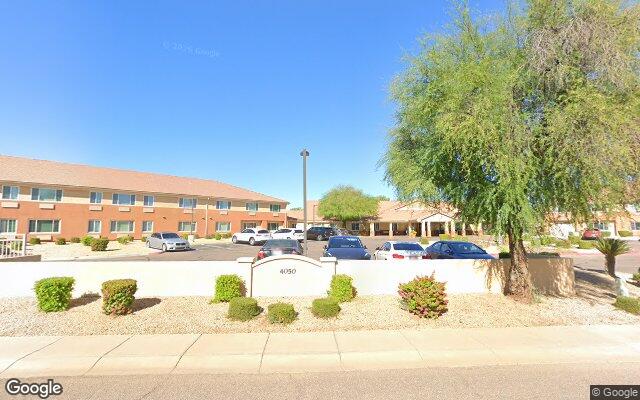
Brookdale Desert Ridge.
A large home, reviewed on public record.
© Google Street View
Compared to 116 Arizona facilities with a similar number of beds.
Care · 36-month window. Higher percentile = better performance on inspection record. Source: Arizona Dept. of Health Services · Bureau of Residential Facilities Licensing.
on file.
Rankings based on 36-month ADHS inspection data. Severity and frequency: fewer citations = higher percentile. Repeat rate: lower repeat citation share = higher percentile.
Citation history, plotted month by month.
80 deficiencies on record. Each bar is a month with a citation.
Finding distribution
80 total · 36 monthsScope × Severity (CMS A–L)
Every inspection visit, verbatim.
17 inspections in the public record, most recent first. Plain-language summaries open first — click into any row for the full citation text.
2026-09-08Complaint InvestigationNo findings
2026-04-16Complaint InvestigationEnforcement · 5 findings
“Based on documentation review, record review, and interview, the governing authority failed to ensure compliance with Arizona Revised Statutes (A.R.S.) § 36-411(A), for one of seven sampled personnel members. The deficient practice posed a risk if the employee was a danger to a vulnerable population. Findings include: 1. A.R.S. § 36-411(A) states: “A. Except as provided in subsection F of this section, as a condition of licensure or continued licensure of a residential care institution, a nursing care institution or a home health agency and as a condition of employment in a residential care institution, a nursing care institution or a home health agency, employees and owners of residential care institutions, nursing care institutions or home health agencies, contracted persons of residential care institutions, nursing care institutions or home health agencies or volunteers of residential care institutions, nursing care institutions or home health agencies who provide medical services, nursing services, behavioral health services, health-related services, home health services or direct supportive services and who have not been subject to the fingerprinting requirements of a health professional's regulatory board pursuant to title 32 shall have a valid fingerprint clearance card that is issued pursuant to title 41, chapter 12, article 3.1 or shall apply for a fingerprint clearance card within twenty working days after employment or beginning volunteer work or contracted work." 2. A review of facility documentation revealed a personnel schedule which indicated E4 worked on March 3-7 and 9-14, 2026. 3. A review of E4’s personnel record revealed a fingerprint clearance card (FCC) dated as expired on March 3, 2026, and a second FCC dated as issued on March 16, 2026. The review revealed no FCC between March 4, 2026, and March 15, 2026. 4. A review of the Department of Public Safety (DPS) website confirmed E4’s first FCC expired on March 3, 2026, and E4’s second FCC was issued on March 16, 2026. The website further revealed DPS received an application for E4’s second FCC on March 3, 2026. 5. In an interview, E1 reported believing a personnel member had to reapply for a new FCC on or before the expiration date of the previous FCC. E1 confirmed E4 worked without a valid FCC. 6. In the exit interview, the Compliance Officer reviewed the findings with E1 and E2 who offered no further comment. This is a repeat citation from the complaint and compliance inspections conducted on July 29 and 31, 2024, and August 23-24, 2023.”
“Based on record review and interview, the manager failed to ensure a caregiver or an assistant caregiver documented the services provided to a resident in the resident's medical record, for two of seven sampled residents. The deficient practice posed a risk as services could not be verified as provided against a service plan. Findings include: 1. A review of R4’s medical medical revealed a service plan dated December 1, 2025. The service plan revealed R4 was to receive assistance with dressing. The review revealed documentation of assisted living services (ADLs) provided to R4 in April 2026. However, the ADLs revealed no documentation of assistance with dressing. 2. In an interview, E1 reported believing the computer system used to create the ADLs was not working properly. E1 reported the system did not add dressing to the ADLs as it should have. E1 stated, “I wonder if it’s a system thing.” 3. A review of R6’s medical medical revealed a service plan dated February 20, 2026. The service plan revealed R6 was to receive assistance with dressing, grooming, and incontinence care. The review revealed ADLs dated April 2026. However, the ADLs revealed no documentation of assistance with dressing, grooming, and incontinence care. 4. In an interview, E1 reported R6’s aforementioned services were not showing up on the caregivers’ task lists. E1 reported caregivers were not able to document on the ADLs if the services were not showing up on the list to be documented. E1 reported R4 and R6 received all required services, but acknowledged not all services were documented. 5. In the exit interview, the Compliance Officer reviewed the findings with E1 and E2 who offered no further comment. This is a repeat citation from the complaint and compliance inspections conducted on July 29 and 31, 2024, and August 23-24, 2023.”
“Based on interview and documentation review, the manager failed to ensure a disaster drill for employees was conducted on each shift at least once every three months and documented. The deficient practice posed a risk if employees were unable to implement a disaster plan. Findings include: 1. In an interview, E1 reported the facility used three shifts: 6:00 AM to 2:00 PM (first shift), 2:00 PM to 10:00 PM (second shift), and 10:00 PM to 6:00 AM (third shift). 2. A review of facility documentation revealed a series of disaster drills dated within the last 12 months. The review revealed the following: - No documentation of disaster drills conducted on the first shift with the last 12 months; - Documentation of disaster drills conducted on the second shift on May 15, 2025; May 18, 2025; August 15, 2025; November 20, 2025; and January 16, 2026; and - Documentation of a disaster drill conducted on the third shift on September 4, 2025. The review revealed facility personnel conducted disaster drills for employees on the second shift at least once every three months but not on the first and third shifts. 3. In an interview, E1 reported not having other disaster drills for the first and third shifts dated within the last twelve months. E1 stated the previous maintenance director “was doing all the drills on the second shift.” 4. In the exit interview, the Compliance Officer reviewed the findings with E1 and E2 who offered no further comment. This is a repeat citation from the complaint and compliance inspection conducted on August 23-24, 2023.”
“Based on documentation review and interview, the manager failed to ensure an evacuation drill for employees and residents was conducted at least once every six months. The deficient practice posed a risk if employees were unable to implement a disaster plan and safely evacuate residents during an emergency. Findings include: 1. A review of facility documentation revealed a series of evacuation drills conducted on August 21, 2025, and March 26, 2026. However, the review revealed more than six months between the two drills. 2. In an interview, E1 stated, “We were a month late on that.” 3. In the exit interview, the Compliance Officer reviewed the findings with E1 and E2 who offered no further comment. This is a repeat citation from the complaint and compliance inspection conducted on July 29 and 31, 2024.”
“Based on documentation review and interview, the manager failed to ensure documentation of each evacuation drill included an identification of residents needing assistance for evacuation. The deficient practice posed a risk if employees were unable to identify residents needing assistance during an evacuation. Findings include: 1. A review of facility documentation revealed documentation of an evacuation drill conducted on August 21, 2025. The document included a place to input the “Room # of those residents who needed assistance to evacuate.” However, the section was left blank and the document did not include an identification of residents needing assistance for evacuation. 2. In an interview, E1 confirmed many residents needed assistance evacuating. E1 acknowledged the document did not include an identification of residents needing assistance for evacuation. 3. In the exit interview, the Compliance Officer reviewed the findings with E1 and E2 who offered no further comment. Technical assistance was provided on this rule during the complaint and compliance inspection conducted on August 23-24, 2023.”
2026-02-23Complaint InvestigationNo findings
2026-01-07Complaint InvestigationR9-10-810.B.1 · 3 findings
“Based on interview and documentation review, the manager failed to ensure a resident was treated with dignity, respect, and consideration. The deficient practice posed a risk as a personnel member chemically restrained a resident. Findings include: 1. In an interview, E1 reported an incident between E3 and R4 involving E3 chemically restraining R4. 2. A review of facility documentation revealed an incident report detailing the aforementioned incident which occurred on December 18, 2025. The report stated: “12/18/2025 at 11:20am, [E4] reported that [R4] said to [E4] last night [R4] was given a medication but was told it was a vitamin by [E3]. [R4] said that it was a lorazepam because of how it makes [R4] feel afterwards. 12/18/2025 at 12:08pm, via phone spoke with [E3]. [E2] asked [E3] if [E3] gave the medication the resident and [E3] said yes, and when asked why, [E3] said [R4] needed it, saying that [R4] kept pushing [R4’s] pendant for things unrelated to care. [E3] was asked if resident refused the medication and [E3] said no, [R4] questioned what it was and I told [R4] it was a vitamin so that [R4] would take it.” 3. In an interview, E1 reported E3’s actions were unacceptable. E1 reported E1 suspended E3’s employment pending investigation. E1 reported E3 resigned shortly thereafter and has not returned to the facility. This is an uncorrected citation from the complaint inspection conducted on December 15, 2025, and the complaint and compliance inspection conducted on July 7, 2025, and a repeat citation from the complaint and compliance inspection conducted on July 29 and 31, 2024.”
“Based on interview and documentation review, the manager failed to ensure a resident was not subjected to restraint, for one of four sampled residents. The deficient practice posed a risk as a personnel member chemically restrained a resident. Findings include: 1. In an interview, E1 reported an incident between E3 and R4 involving E3 chemically restraining R4. 2. A review of facility documentation revealed an incident report detailing the aforementioned incident which occurred on December 18, 2025. The report stated: “12/18/2025 at 11:20am, [E4] reported that [R4] said to [E4] last night [R4] was given a medication but was told it was a vitamin by [E3]. [R4] said that it was a lorazepam because of how it makes [R4] feel afterwards. 12/18/2025 at 12:08pm, via phone spoke with [E3]. [E2] asked [E3] if [E3] gave the medication the resident and [E3] said yes, and when asked why, [E3] said [R4] needed it, saying that [R4] kept pushing [R4’s] pendant for things unrelated to care. [E3] was asked if resident refused the medication and [E3] said no, [R4] questioned what it was and I told [R4] it was a vitamin so that [R4] would take it.” 3. In an interview, when the Compliance Officer informed E1 using a medication in such a manner is considered chemical restraint, E1 agreed, stating, “Right.” E1 reported E3’s actions were unacceptable. E1 reported E1 suspended E3’s employment pending investigation. E1 reported E3 resigned shortly thereafter and has not returned to the facility.”
“Based on documentation review, record review, and interview, the manager failed to ensure a medication was administered in compliance with a medication order, for three of four sampled residents. The deficient practice posed a risk if the resident experienced a change in condition due to improper administration of medication and as the Department was provided false or misleading information. Findings include: 1. A review of Department documentation revealed a Plan of Correction (POC) for this deficiency from the complaint inspection conducted on July 30, 2025. The POC indicated this deficiency was corrected on October 24, 2025. The POC stated, “All residents are receiving their medications as ordered by 10/24/2025.” 2. A review of R1's medical record revealed R1’s date of occupancy was before October 24, 2025 (the date on the POC). The review revealed a current service plan which indicated R1 received medication administration. The review further revealed a series of medication administration records (MARs) dated December 2025 and January 2026. The MARs indicated facility personnel administered allopurinol, aspirin, famotidine, levothyroxine, metoprolol, and simvastatin to R1 in December 2025 and January 2026. However, the review revealed no signed medication orders for the six medications. 3. In an interview, E2 reported E2 was unable to find R1’s orders for the six aforementioned medications. 4. A review of R2's medical record revealed a current service plan which indicated R2 received medication administration. The review revealed a series of MARs dated December 2025 and January 2026. The MARs indicated facility personnel administered aspirin to R2 in December 2025 and aspirin and quetiapine to R2 in January 2026. However, the review revealed no signed medication orders for the two medications. 5. A review of R4's medical record revealed R4’s date of occupancy was before October 24, 2025 (the date on the POC). The review revealed a current service plan which indicated R4 received medication administration. The review further revealed a MAR dated December 2025 which indicated facility personnel administered aspirin, levothyroxine, and lorazepam to R4. However, the review revealed no signed medication orders for the three medications. This is a repeat citation from the complaint inspection conducted on July 30, 2025.”
2025-12-15Complaint InvestigationR9-10-810.B.1 · 2 findings
“Based on interview and documentation review, the manager failed to ensure a resident was treated with dignity, respect, and consideration. The deficient practice posed a risk if personnel could not react to a resident's needs or emergencies. Findings include: 1. In an interview, E1 reported an incident between R3 and E3, stating, “We had an associate remove a resident’s pendant.” E1 reported E3 removed the pendant from R3’s room and did not return it until the end of E3’s overnight shift several hours later. 2. A review of facility documentation revealed an incident report detailing an incident between R3 and E3 on October 26, 2025. The report stated: “On 10/27/2025 [at] approximately 10:52am, [E4] reported to [E2] that [R3] said that [E3] took [R3’s] pendant away from [R3], threw it and that [R3] did not have it from 1 am until [R3] woke up at 8 am.” The report further stated, “[E3] was suspended pending investigation via phone as soon as was possible following report.” 3. In an interview, E1 reported E3 taking R3’s pendant was unacceptable and E1 terminated E3 shortly after E1 was made aware of the situation. This is an uncorrected citation from the complaint and compliance inspection conducted on July 7, 2025, and a repeat citation from the complaint and compliance inspection conducted on July 29 and 31, 2024.”
“Based on record review, interview, documentation review, and observation, the manager failed to ensure a bell, intercom, or other mechanical means to alert employees to a resident’s needs or emergencies was available and accessible in a bedroom being used by a resident receiving personal care services. The deficient practice posed a risk if personnel could not react to a resident's needs or emergencies. Findings include: 1. A review of R3’s medical record revealed a service plan which indicated R3 received personal care services. 2. In an interview, E1 reported an incident between R3 and E3, stating, “We had an associate remove a resident’s pendant.” E1 reported E3 removed the pendant from R3’s room and did not return it until the end of E3’s overnight shift several hours later. 3. A review of facility documentation revealed an incident report detailing an incident between R3 and E3 on October 26, 2025. The report stated: “On 10/27/2025 [at] approximately 10:52am, [E4] reported to [E2] that [R3] said that [E3] took [R3’s] pendant away from [R3], threw it and that [R3] did not have it from 1 am until [R3] woke up at 8 am.” The report further stated, “[E3] was suspended pending investigation via phone as soon as was possible following report.” 4. In an interview, E1 reported E3 taking R3’s pendant was unacceptable and E1 terminated E3 shortly after E1 was made aware of the situation. 5. The Compliance Officer observed R3’s pendant in R3’s bedroom within R3’s reach. However, the Compliance Officer observed no bell, intercom, or other mechanical means to alert employees to R3’s needs or emergencies that would have been available and accessible in R3’s bedroom when R3 did not have R3’s pendant.”
2025-09-16Complaint InvestigationNo findings
2025-07-30Complaint InvestigationR9-10-803.K.2 · 4 findings
“Based on interview and documentation review, the manager failed to provide written notification to the Department of a resident’s self-injury, within two working days after the resident inflicted a self-injury that requires immediate intervention by an emergency services provider, for one of three sampled residents. Findings include: 1. In an interview, E1 reported R3 had an accident, emergency, or injury that resulted in R3 needing medical services on July 14, 2025. 2. A review of facility documentation revealed an “INCIDENT INVESTIGATION” report dated July 14-15, 2025. The report stated: “[E3] enters [R3’s] room and resident appeared to be sleeping and snoring. [E3] approaches and attempts to wake [R3] for [R3’s] afternoon meds and [R3] does not wake. [E3] attempts several times shaking [R3’s] shoulder and rubbing [R3’s] leg without response. [E3] calls for assistance and hospice nurse [O1] enters room and [E3 and O1] continue to try to rouse [R3] and upon rolling [R3] to [R3’s] back [E3 and O1] find pills stuck to [R3’s] face, lips and the inside of [R3’s] mouth. At this time [E3 and O1] are unable to get a response and call 911…07/15/2025 - Approximately 1000am - Spoke to [individual] at Suncrest Hospice - [R3] is recovered and back to baseline.” 3. In an interview, E1 reported E1 originally thought the incident constituted self injury. However, E1 confirmed E1 reported the self injury to Adult Protective Services and not to the Department. E1 reported R1’s family later commented about the incident, not believing it was a case of self injury. E1 reported the hospital found no traces of opioids or of an overdose.”
“Based on record review, interview, and observation, the manager failed to ensure a resident's medical record contained documentation of medication administered to the resident that included the date and time of administration or assistance, the dosage, and the name and signature of the individual administering the medication, for one of three sampled residents. The deficient practice posed a risk as the Department was provided false or misleading information. Findings include: 1. A review of R1’s medical record revealed an unsigned medication order for “MIRTAZAPINE 15 ORAL TABLET 0.5 tab PO QHS x 8 days then increase to 1 tab PO QHS 30 day(s)” dated July 8, 2025. The review revealed a medication administration record (MAR) dated July 2025. The MAR revealed the following: - On July 9-13, 2025, facility personnel administered R1 one half-tablet of mirtazapine 15 mg (7.5 mg); - On July 14-16, 2025, facility personnel did not administer R1 one half-tablet of mirtazapine 15 mg (7.5 mg), with notes to “See Med Note;” - On July 17, 2025, facility personnel did not administer R1 one tablet of mirtazapine 15 mg, with notes to “See Med Note;” - On July 18, 2025, facility personnel administered R1 one tablet of mirtazapine 15 mg; - On July 19-20, 2025, facility personnel did not administer R1 one tablet of mirtazapine 15 mg; and - On July 21-29, 2025, facility personnel administered R1 one tablet of mirtazapine 15 mg. The MAR revealed documentation demonstrating facility personnel administered a total of five half-tablets and 10 full tablets. The review further revealed an “Alert Charting Note” dated July 17, 2025, at 9:40 PM created by E2. The note stated: “Called [R1’s family member] about non payment of pharmacy bill. Confirmed that [R1’s family member] will get in touch with [R1’s other family member] to settle the matter. [R1’s family member] promised to settle the matter by the close of the business. 2. In an interview, E1 reported the pharmacy did not deliver the medication on time because the pharmacy bill had not been paid at the time. E1 reported E1 did not know exactly when the medication was delivered. 3. The Compliance Officer observed R1’s pharmacy-provided multi-dose package of mirtazapine. The package revealed the medication was delivered on July 22, 2025, and only eight tablets had been administered, in contrast with the 15 and a half tablets documented as administered on the MAR. 4. In a telephonic interview, E2 reported the mirtazapine had not been delivered for several days after July 8, 2025. E2 reported the medication was not administered on those dates, though E2 reported not remembering the exact dates. E2 stated the medication was “not given” on July 18, 2025, even though it was documented by E2 as administered. E2 reported having not administered half-tablets of the medication to R1. E2 confirmed E2 administered only full tablets of the medication to R1. E2 stated the issues with the administration and documentation constituted a “med error.””
“Based on record review and interview, the manager failed to ensure medication administered to a resident was administered in compliance with a medication order, for two of three sampled residents. The deficient practice posed a risk if a resident experienced a change in condition due to improper administration of medication. Findings include: 1. A review of R1’s medical record revealed a current service plan which indicated R1 received medication administration. The review revealed a medication administration record (MAR) dated July 2025. The MAR revealed facility personnel administered mirtazapine to R1 on July 9-13, 18, and 21-29, 2025. However, the review revealed no signed medication order for the mirtazapine. 2. In an interview, E1 confirmed caregivers administered R1’s mirtazapine. 3. In a telephonic interview, E2 confirmed E2 administered R1’s mirtazapine during E2’s shifts on July 9-13 and 21-29, 2025. 4. A review of R3’s medical record revealed a current service plan which indicated R3 received medication administration. The review revealed a MAR dated July 2025. The MAR revealed facility personnel administered multiple medications on a daily basis to R3 on July 1-14, 2025. However, the review revealed no signed medication orders.”
“Based on interview and documentation review, the manager failed to ensure a caregiver or an assistant caregiver immediately notified the resident's primary care provider (PCP) when a resident had an accident, emergency, or injury that resulted in the resident needing medical services. The deficient practice posed a potential risk of re-injury if a resident did not receive adequate follow-up care. Findings include: 1. In an interview, E1 reported R3 had an accident, emergency, or injury that resulted in R3 needing medical services on July 14, 2025. 2. A review of facility documentation revealed an “INCIDENT INVESTIGATION” report dated July 14-15, 2025. The report revealed R3 had an accident, emergency, or injury that resulted in R3 needing medical services. The report revealed no documentation demonstrating whether facility personnel contacted R3’s PCP. 3. In an interview, when the Compliance Officer asked if R3’s PCP was hospice, E1 reported it was not. E1 confirmed R3 had a PCP separate from hospice. E1 reported facility personnel contacted R3’ hospice when the incident occurred and not R3’s PCP. When the Compliance Officer asked if E1 had documentation of notification of R3’s PCP immediately following the incident, E1 stated, “We don’t.” This is a repeat citation from the complaint and compliance inspections completed on July 31, 2024, and August 24, 2023.”
2025-07-07Complaint InvestigationR9-10-808.C.1.a · 2 findings
“Based on record review and interviews, the manager failed to ensure that a caregiver or an assistant caregiver provided a resident with the assisted living services in the resident's service plan for one of two residents reviewed. The deficient practice posed a risk as service plan to directed services was not followed. Findings include: 1. A review of R8's service plan revealed a service plan for Personal Care services that included incontinence care with changing every two hours or as needed. 2. A review of a progress note dated March 9, 2025, revealed that R8 requested incontinence care assistance from E8 around 1am. E8's progress note stated "resident wanted to be changed but was not that wet, resident told to wait two hours for scheduled change." The resident requested for assistance a second time around 3:30 am and was assisted by E8. 3. A review of the facility's Policies and Procedures titled, "Scope of Services', stated, "Personal Care services includes assistance with activities of daily living that can be performed by persons without professional skills or professional training. Additionally, it includes the coordination or provision of intermittent nursing services and the administration of medications and treatments by a licensed nurse or as otherwise provided by law." 4. During the exit interview, E1 acknowledged that a caregiver or an assistant caregiver failed to provide a resident with the assisted living services in the resident's service plan.”
“Based on record review, documentation review, and interview, the manager failed to ensure that a resident was treated with dignity, respect, and consideration. The deficient practice posed a risk of injury and violated a resident's rights. Findings include: 1. A review of R8's service plan revealed that the resident received Personal Care services, which included incontinence care. 2. A review of a progress note dated March 9, 2025, revealed that R8 requested incontinence care assistance from E8 around 1am. E8's progress note stated "resident wanted to be changed but was not that wet, resident told to wait two hours for scheduled change." The resident requested for assistance a second time around 3:30 am and was assisted by E8. 3. A review of E8's personnel record revealed that the employee was put on suspension pending an internal investigation on March 16, 2025. The employee was terminated for violation of facility policy on April1, 2025. 4. A review of the facility's Policies and Procedures titled, "Resident Rights" stated, "Residents will be treated with dignity, respect, and consideration." 5. In an interview, E1 revealed that when the manager learned of the behavior that E8 exhibited towards R8, the employee was suspended pending an investigation. The employee was terminated for violating policy. 6. In an interview, E1 acknowledged that the manager failed to ensure that a resident was treated with dignity, respect, or consideration.”
2025-04-11Complaint InvestigationA.A.C. · 30 findings
“36-420. Health care institutions; cardiopulmonary resuscitation; first aid; immunity; falls; definition B. Each health care institution: 2. Shall provide appropriate first aid in accordance with its certification training for first aid before the arrival of emergency medical services to a resident who is in distress and to a noninjured resident who has fallen, appears to be uninjured and is unable to reasonably recover independently. The first aid shall be in accordance with the resident's advance directives, if known. Staff who are certified in first aid shall be available at all times.”
“36-420.01. Health care institutions; fall prevention and fall recovery; training programs; definition A. Each health care institution shall develop and administer a training program for all staff regarding fall prevention and fall recovery. The training program shall include initial training and continued competency training in fall prevention and fall recovery. A health care institution may use information and training materials from the department's Arizona falls prevention coalition in developing the training program.”
“A. A governing authority shall: 5. Review and evaluate the effectiveness of the quality management program at least once every 12 months;”
“A. A governing authority shall: 9. Ensure compliance with A.R.S. § 36-411.”
“J. If a manager has a reasonable basis, according to A.R.S. § 46-454 , to believe abuse, neglect or exploitation has occurred on the premises or while a resident is receiving services from an assisted living facility's manager, caregiver, or assistant caregiver, the manager shall: 5. Initiate an investigation of the suspected abuse, neglect, or exploitation and document the following information within five working days after the report required in subsection (J)(2): d. The actions taken by the manager to prevent the suspected abuse, neglect, or exploitation from occurring in the future; and”
“A. A manager shall ensure that: 4. A caregiver's or assistant caregiver's skills and knowledge are verified and documented: a. Before the caregiver or assistant caregiver provides physical health services or behavioral health services, and b. According to policies and procedures;”
“A. A manager shall ensure that: 5. An assisted living facility has a manager, caregivers, and assistant caregivers with the qualifications, experience, skills, and knowledge necessary to: c. Ensure the health and safety of a resident;”
“A. A manager shall ensure that: 7. Documentation is maintained for at least 12 months after the last date on the documentation of the caregivers and assistant caregivers working each day, including the hours worked by each;”
“A. A manager shall ensure that: 8. A manager, a caregiver, and an assistant caregiver, or an employee or a volunteer who has or is expected to have more than eight hours per week of direct interaction with residents, provides evidence of freedom from infectious tuberculosis: a. On or before the date the individual begins providing services at or on behalf of the assisted living facility, and b. As specified in R9-10-113;”
“A. A manager shall ensure that: 9. Before providing assisted living services to a resident, a caregiver or an assistant caregiver receives orientation that is specific to the duties to be performed by the caregiver or assistant caregiver; and”
“A. Except as provided in R9-10-808(B)(2), a manager shall ensure that a resident provides evidence of freedom from infectious tuberculosis: 1. Before or within seven calendar days after the resident's date of occupancy, and 2. As specified in R9-10-113.”
“A. Except as required in subsection (B), a manager shall ensure that a resident has a written service plan that: 3. Includes the following: a. A description of the resident's medical or health problems, including physical, behavioral, cognitive, or functional conditions or impairments;”
“A. Except as required in subsection (B), a manager shall ensure that a resident has a written service plan that: 4. Is reviewed and updated based on changes in the requirements in subsections (A)(3)(a) through (f): b. As follows: ii. At least once every six months for a resident receiving personal care services, and”
“A. Except as required in subsection (B), a manager shall ensure that a resident has a written service plan that: 5. When initially developed and when updated, is signed and dated by: a. The resident or resident's representative; b. The manager; c. If a review is required in subsection (A)(3)(d), the nurse or medical practitioner who reviewed the service plan; and d. If a review is required in subsection (A)(3)(e)(ii), the medical practitioner or behavioral health professional who reviewed the service plan.”
“C. A manager shall ensure that: 1. A caregiver or an assistant caregiver: g. Documents the services provided in the resident's medical record; and”
“B. A manager shall ensure that: 1. A resident is treated with dignity, respect, and consideration;”
“C. A manager shall ensure that a resident's medical record contains: 17. Documentation of notification of the resident of the availability of vaccination for influenza and pneumonia, according to A.R.S. § 36-406(1)(d);”
“F. In addition to the requirements in R9-10-808(A)(3), a manager shall ensure that the service plan for a resident receiving personal care services includes: 1. Skin maintenance to prevent and treat bruises, injuries, pressure sores, and infections;”
“B. A manager of an assisted living facility authorized to provide directed care services shall not accept or retain a resident who, except as provided in R9-10-814(B)(2): 1. Is confined to a bed or chair because of an inability to ambulate even with assistance; or”
“C. In addition to the requirements in R9-10-808(A)(3), a manager shall ensure that the service plan for a resident receiving directed care services includes: 7. Coordination of communications with the resident's representative, family members, and, if applicable, other individuals identified in the resident's service plan.”
“C. A manager shall ensure that food is obtained, prepared, served, and stored as follows: 5. A refrigerator used by an assisted living facility to store food or medication contains a thermometer, accurate to plus or minus 3° F, placed at the warmest part of the refrigerator;”
“C. A manager shall ensure that food is obtained, prepared, served, and stored as follows: 7. Tableware, utensils, equipment, and food-contact surfaces are clean and in good repair.”
“A. A manager shall ensure that: 5. An evacuation drill for employees and residents: a. Is conducted at least once every six months; and”
“D. When a resident has an accident, emergency, or injury that results in the resident needing medical services, a manager shall ensure that a caregiver or an assistant caregiver: 1. Immediately notifies the resident's emergency contact and primary care provider; and”
“D. When a resident has an accident, emergency, or injury that results in the resident needing medical services, a manager shall ensure that a caregiver or an assistant caregiver: 2. Documents the following: f. Any action taken to prevent the accident, emergency, or injury from occurring in the future.”
“A. A manager shall ensure that: 1. The premises and equipment used at the assisted living facility are: a. Cleaned and, if applicable, disinfected according to policies and procedures designed to prevent, minimize, and control illness or infection; and”
“A. A manager shall ensure that: 3. Garbage and refuse are: a. Stored in covered containers lined with plastic bags, and”
“A. A manager shall ensure that: 11. Poisonous or toxic materials stored by the assisted living facility are maintained in labeled containers in a locked area separate from food preparation and storage, dining areas, and medications and are inaccessible to residents;”
“R9-10-113. Tuberculosis Screening A. If a health care institution is subject to the requirements of this Section, as specified in an Article in this Chapter, the health care institution's chief administrative officer shall ensure that the health care institution establishes, documents, and implements tuberculosis infection control activities that: 2. Include: c. Annually providing training and education related to recognizing the signs and symptoms of tuberculosis to individuals employed by or providing volunteer services for the health care institution;”
“R9-10-120. Opioid Prescribing and Treatment F. For a health care institution where opioids are administered as part of treatment or where a patient is provided assistance in the self-administration of medication for a prescribed opioid, including a health care institution in which an opioid may be prescribed or ordered as part of treatment, a medical director, a manager as defined in R9-10-801, or a provider, as applicable to the health care institution, shall: 4. Except as provided in subsection (H), ensure that an individual authorized by policies and procedures to administer an opioid in treating a patient or to provide assistance in the self-administration of medication for a prescribed opioid: a. Before administering an opioid or providing assistance in the self-administration of medication for a prescribed opioid in compliance with an order as part of the treatment for a patient, identifies the patient's need for the opioid; b. Monitors the patient's response to the opioid; and c. Documents in the patient's medical record: i. An identification of the patient ' s need for the opioid before the opioid was administered or assistance in the self-administration of medication for a prescribed opioid was provided, and ii. The effect of the opioid administered or for which assistance in the self-administration of medication for a prescribed opioid was provided.”
2025-03-07Complaint InvestigationR9-10-808.A.3.c · 1 finding
“Based on documentation review, record review, and interview, the manager failed to ensure a resident's written service plan included the amount, type, and frequency of assisted living services being provided to the resident, for two of two residents sampled. The deficient practice posed a risk as the service plans did not reinforce and clarify services to be provided to a resident. Findings include: 1. A review of the facility's policies and procedures revealed a policy titled "Night Check Policy," last revised: November 2018. The policy stated "Policy Overview - Resident care staff should make night checks of the residents. A resident or his/her legally responsible party may choose not to have the associates perform night checks. The choice not to receive night checks should be documented in a Negotiated Risk Agreement, where permitted by state regulation, and on the resident's Service Plan. Policy Detail: 1. Associates should perform night checks approximately every four (4) to six (6) hours or as determined by the residents' need…” 2. A review of R1's Activities of Daily Living (ADL) sheets indicated night checks were provided by the caregivers on January, February and March 2025. 3. A review of R2’s Activities of Daily Living (ADL) sheets indicated night checks were provided by the caregivers on January and February 2025. 4. A review of R1's and R2's medical records revealed current service plans. However, the service plans did not include the frequency of night checks or the choice not to have night checks. Additionally, the medical records did not include a documented Negotiated Risk Agreement as specified in the policy. 5. A review of R2's medical record revealed a current service plan dated December 25, 2024. The service plan stated, "[R2] requires staff assist with all transfers…[R2] is non-weight bearing and requires care staff to use Geri chair for ambulation through the facility. [R2] is a 2 person assist with the use of a mechanical lift for transfers." However, there was no documentation of the need for repositioning the resident. 6. In an interview, E2 reported the staff repositioned R2 every two hours with incontinence care. 7. In an interview, E1 and E2 acknowledged R1’s and R2's written service plans did not include the amount, type, and frequency of the above mentioned services provided to the residents.”
2024-12-31Complaint InvestigationNo findings
2024-10-22Complaint InvestigationNo findings
2024-09-24Complaint InvestigationNo findings
2024-08-21Complaint InvestigationNo findings
2024-08-09Complaint InvestigationA.A.C. · 1 finding
“Based on record review and interview,the manager failed to ensure a resident had a written service plan which was signed and dated by the resident or resident's representative, the manager, and if a review was required, by the nurse or medical practitioner who reviewed the service plan. This posed a health and safety risk if the resident or resident's representative, the manager, and the nurse or medical practitioner did not acknowledge the services that were to be provided. Findings include: 1. R9-10-808.A(3)(d) states "For a resident who requires intermittent nursing services or medication administration, review by a nurse or medical practitioner." 2. 4. In record review, the medical record for R1 (received personal care and medication administration services), did not include documentation the resident's service plan was signed and dated by the resident or resident's representative, the manager, and the nurse or medical practitioner for the service plans dated December 12, 2023 and June 16, 2024. 3. During an interview, E1 and E2 both reported the system for obtaining signatures on the service plan changed and there was no further documentation available for review. E1 and E2 acknowledged the service plans were not signed and dated by the resident or resident's representative, the manager, and signed and dated as reviewed by the nurse or medical practitioner, as required. This is an uncorrected deficiency from the compliance survey conducted on July 31, 2024.”
2024-08-07Complaint InvestigationA.A.C. · 2 findings
“Based on documentation review and interview, the manager failed to ensure policies and procedures were established and documented to protect the health and safety of a resident covering how a caregiver would respond to a resident's sudden, intense, or out of control behavior to prevent harm to the resident or another individual. The deficient practice posed a health and safety risk to residents, if the facility failed to have established policies and procedures, and employees were not instructed on managing a resident's aggressive behaviors, to ensure the safety of residents and others. Findings include: 1. A review of the facility's policies and procedures revealed a policy titled, "Behavioral Problem-Solving Process and Procedure," that stated "1. Once a behavioral expression has been identified, the community team should meet to explore and clarify the symptoms that are associated with the resident's distress." "8. In the event a resident's behavioral expression poses immediate danger to the resident or others, please ensure the safety of the residents first and eliminate the immediate danger." 2. A review of R1's medical record revealed the following document titled "Charting Note" dated July 31, 2024; - at 02:07pm that stated "R1 was very upset this afternoon, R1 was yelling at everyone care staff, Med-Tech and activities director. R1 said R1 was the head of every one and had to speak for all other residents, very hard to redirect, did not want to listen to anyone, R1 set off a couple of residents ... After a while R1 was able to be re-directed to take nap." - at 08:05pm that stated " ... R1 kept screaming ... yelling in the hallways agitating other residents. ..." - at 10:50pm that stated "Came out of R1's room, yelling at R2, calling R2 names, then E5 witnesses R1 punching R2 in the face then hit R2 with the walker in R2's right arm. E5 intervene separated R1 and R2. About 10 mins later E5 came out from assisting another resident, found R1 on the floors and R2's shirt is off and ripped, a witness told E5 that R1 grabbed R2 by the shirt and it ripped so R2 pushed R1. R1 has a skin tear on left hand, refused vitals." 3. A review of facility documentation revealed no evidence provided to the Compliance Officer that the facility had implemented measures as outlined in the "Behavioral Problem-Solving Process and Procedure" policy. The Compliance Officer was unable to determine what specific actions the facility had taken to separate the residents during the incident, and prevent similar incidents from occurring in the future. 4. In an interview, E2 and E3 acknowledged that the caregiver did not take immediate action to separate the residents during the incident on July 31, 2024 and acknowledged the facility policy covering how a caregiver will respond to a resident's sudden, intense, or out-of-control behavior to prevent harm to the resident or another individual had not been implemented.”
“Based on documentation review, record review, observation and interview, the manager failed to ensure if a manager had a reasonable basis, according to A.R.S. \'a7 46-454, to believe abuse had occurred on the premises, the manager complied with all the requirements in R9-10-803(J). The deficient practice posed a potential safety risk for residents and potential rights violation if alleged abuse, neglect, or exploitation was not reported as required. Findings include: 1. A.R.S. \'a7 46-454. stated, "Duty to report abuse, neglect and exploitation of vulnerable adults; duty to make medical records available; violation; classification A. A health professional...or other person who has responsibility for the care of a vulnerable adult and who has a reasonable basis to believe that abuse, neglect or exploitation of the adult has occurred shall immediately report or cause reports to be made of such reasonable basis to a peace officer or to the adult protective services central intake unit...All of the above reports shall be made immediately by telephone or online. B. If an individual listed in subsection A of this section is an employee or agent of a health care institution as defined in section 36-401 and the health care institution's procedures require that all suspected abuse, neglect and exploitation be reported to adult protective services as required by law, the individual is deemed to have complied with the requirements of subsection A of this section by reporting or causing a report to be made to the health care institution in accordance with the health care institution's procedures." 2. A review of R1's medical record revealed a document titled "Charting Note" dated July 31, 2024 at 10:50pm that stated "Came out of R1's room, yelling at R2, calling R2 names, then E5 witnesses R1 punching R2 in the face then hit R2 with the walker in R2's right arm. E5 intervene separated R1 and R2. About 10 mins later E5 came out from assisting another resident, found R1 on the floors and R2's shirt is off and ripped, a witness told E5 that R1 grabbed R2 by the shirt and it ripped so R2 pushed R1. R1 has a skin tear on left hand, refused vitals." 3. R1's medical record revealed no documentation that the facility took immediate action to stop the suspected abuse and no documentation of reporting the incident to Adult Protective Services (APS) or a Peace Officer (police). Additionally, no documentation was available to show an investigation was conducted by the facility of the suspected abuse. 4. In an interview, R1 reported that R2 pushed R1, causing R1 to fall. As a result of the fall, R1 suffered a skin tear and hit R1's head, though no head injury was mentioned. 5. A review of R2's medical record revealed a document titled "Charting Notes" dated July 31, 2024 at 10:41pm that stated "Was physically attacked by two residents, One in the middle of R2's back and the other in the face. R2's skin tear on the right upper arm open up. No signs of bruising on the back and face. 6. R2's medical record revealed no documentation that the facility took immediate action to stop the suspected abuse and no documentation of reporting the incident to Adult Protective Services (APS) or a Peace Officer (police). Additionally, no documentation was available to show an investigation was conducted by the facility of the suspected abuse. 7. During an environmental tour, the Compliance Officer observed R2 wandering throughout the memory care unit, opening doors. The facility has identified R2 as a wanderer. However, the Compliance Officer was unable to determine what specific measures the facility had implemented to separate the residents and prevent similar incidents from occurring in the future. 8. In an interview, E2 and E3 acknowledged the facility did not take immediate action to stop the suspected abuse, report the abuse to Adult Protective Services (APS) or a Peace Officer (police), and no investigation was conducted by the facility of the suspected abuse. 9. E1 arrived around the time the Compliance Officer was about to leave the facility. In an interview, E1 acknowledged the facility did not take immediate action to stop the suspected abuse, report the abuse to Adult Protective Services (APS) or a Peace Officer (police), and no investigation was conducted by the facility of the suspected abuse. E1 reported that E1 was notified of the incident the day before (August 6, 2024) the Compliance Officer was at the facility.”
2024-07-29Complaint InvestigationA.A.C. · 30 findings
“Based on record review and interview, the health care institution failed to provide appropriate first aid to a non-injured resident who had fallen, appeared to be uninjured, and was unable to reasonably recover independently, for one of one resident reviewed. The deficient practice posed a risk as the facility left a resident on the floor instead of providing first aid to a non-injured resident by assisting them off the floor after a fall. Findings include: 1. A review of R8's medical record revealed a document titled "Progress Notes" that stated the following: -June 8, 2024 - "... resident stood up and then immediately started going to down... staff gently guided (R8) to the floor. There were no injuries sustained... call EMS to assist with getting up..." -June 23, 2024 - "had a fall next too (R8's) bed. fire department had to come and help with assistance with (R8) on the floor. no injuries..." -July 3, 2024 - "...Resident fall occurred 07/03/2024 1:35 AM...There were no physical signs of head injury... Emergency medical services were contacted helped (R8) get back in bed." 2. In an interview, E1, E5, and E6 acknowledged the facility failed to provide appropriate first aid to a non-injured resident.”
“Based on documentation review, record review, and interview, the manager failed to ensure the health care institution developed and administered a training program for all staff regarding fall prevention and fall recovery that included continued competency training, for five of eleven staff reviewed. The deficient practice posed a risk to the physical health and safety of a resident. Findings include: 1. A review of the facility's policies and procedures revealed a policy titled "Falls Management Policy" with an effective date of October 2013. This policy stated "1. The Executive Director (ED) is responsible for verifying that associates have completed the Brookdale Foundations Falls Management training course during orientation and should be reviewed annually thereafter..." 2. A review of E1's personnel record revealed E1 worked as the manager and had a hire date of January 26, 2023. The personnel record revealed documentation of "Falls Management" training dated August 31, 2022. However, current documentation was not available indicating E1 completed fall prevention and fall recovery training. 3. A review of E10's personnel record revealed E10 worked as a caregiver and had a hire date of June 30, 2022. The personnel record revealed documentation of "Falls Management" training dated June 14, 2023. However, current documentation was not available indicating E10 completed fall prevention and fall recovery training. 4. A review of E11's personnel record revealed E11 worked as a caregiver and had a hire date of December 22, 2016. The personnel record revealed documentation of "Falls Management" training dated March 5, 2021. However, current documentation was not available indicating E11 completed fall prevention and fall recovery training. 5. A review of E13's personnel record revealed E13 worked as a caregiver and had a hire date of October 21, 2018. The personnel record revealed documentation of "Falls Management" training dated April 20, 2022. However, current documentation was not available indicating E13 completed fall prevention and fall recovery training. 6. A review of E15's personnel record revealed E15 worked as a caregiver and had a hire date of October 24, 2022. The personnel record revealed documentation of "Falls Management" training dated October 25, 2022. However, current documentation was not available indicating E15 completed fall prevention and fall recovery training. 7. In an interview, E1 and E5 acknowledged documentation was not available that showed E1, E10, E11, E13, and E15 had completed continued competency training in fall prevention and fall recovery.”
“Based on documentation review and interview, the manager failed to review and evaluate the effectiveness of the quality management program at least once every 12 months. The deficient practice posed a risk as a quality management program documents the necessary information required to effectively manage services provided. Findings include: 1. In documentation review, the facility's policy, titled "...Quality Improvement Program," was dated January 3, 2019. There was no documentation the quality improvement program was reviewed and evaluated at least once every 12 months. 2. During an interview, the findings were reviewed with E1 and E5, who acknowledged the facility did not have documentation of a review or evaluation of the effectiveness of the quality management program.”
“Based on documentation review, record review, and interview, the governing authority failed to ensure compliance with A.R.S. \'a7 36-411, for two of eleven employees reviewed. The deficient practice posed a risk if the employee was a danger to a vulnerable population. Findings include: 1. A.R.S. \'a7 36-411 states, " ...C. Owners shall make documented, good faith efforts to: 1. Contact previous employers to obtain information or recommendations that may be relevant to a person's fitness to work in a residential care institution..." 2. A review of E10's personnel record revealed E10 worked as a caregiver and had a hire date of June 30, 2022. The personnel record revealed no documentation of good faith efforts to contact previous employers to obtain information or recommendations that may be relevant to E10's fitness to work in a residential care institution. 3. A review of E12's personnel record revealed E12 worked as a caregiver and had a hire date of August 22, 2022. The personnel record revealed no documentation of good faith efforts to contact previous employers to obtain information or recommendations that may be relevant to E12's fitness to work in a residential care institution. 4. In an interview, E1 and E5 acknowledged documentation was not available that showed E10's and E12's work references were obtained upon hire at the facility. This is a repeat deficiency from the compliance and complaint inspection conducted August 24, 2023.”
“Based on documentation review and interview, the manager failed to document the actions taken to prevent an alleged incident of abuse from occurring in the future, according to Arizona Revised Statutes (A.R.S.) \'a7 46-454. The deficient practice posed a risk as residents were not adequately protected from abuse. Findings include: 1. A review of facility documentation revealed a document titled "Incident Report Log" dated September 24, 2023. This document stated "(E11) reported to management that resident (R9) started yelling at caregiver (E10) yesterday morning when (E10) entered (R9's) room on the morning of 9-25-23. (E10) assigned to (R9) on 9-24-23 and 9-25-23. (R9) told (E11) "(E10) is abusing me."(E11) asked how (E10) was abusing (R9), (R9) stated "(E10) is playing with me, (E10) is not nice, (E10) sexually abuses me all the time." HWD and ED interviewed (R9) after the allegations were reported. (R9) told HWD and ED "(E10) molested me and asked if I liked it." (R9) reported (E10) put (E10's) hands inside of (R9's) (genitalia) and that (E10) molested (R9) after lunch time of 9-24-23. Notified (O1) of the allegation, neither (O1) nor (R9) want to file a police report at this time." 2. A review of facility documentation revealed a document titled "Assisted Living Incident Investigation Summary" dated September 25, 2023. This document stated " ... Members of management (ED, nurse director, Business/HR) talked with (R9) who confirmed that (E10) had 'molested' (R9) ... Staff interviews revealed one other resident named (R11) reported initial concerns about (E10), but when re-interviewed (R11) denied any concerns ...Allegation was not substantiated." This documentation did not include the actions taken to prevent an alleged incident of abuse from occurring in the future. 3. A review of the September 2023 personnel schedule revealed E10 work the "first shift" in the assisted living area. 4. A review of the October 2023 - July 2024 personnel schedules revealed E10 continued to work the "first shift" in the assisted living area or memory care unit October 22, 2023 - present, continuing to have access to R9 who reported the abuse. 5. During an interview, E1 reported the facility did not do anything after this incident to monitor for future incidents.”
“Based on documentation review, record review, observation, and interview, the manager failed to ensure a caregiver's skills and knowledge were verified and documented before providing physical health services and according to policies and procedures, for two of eleven caregivers reviewed. The deficient practice posed a risk if the employees were unable to meet a resident's needs and the Department was provided false or misleading information. Findings include: 1. A review of the facility's policies and procedures revealed a policy titled "Skills & Competency Evaluation Policy" with an effective date documented as April 2024. This policy stated " ...2. Upon hire and as needed, the skills sets or competencies will be assessed/evaluate through a variety of methods, including but not limited to: ...d. Demonstration and documentation of required competencies prior to providing resident care." 2. A review of E14's personnel record revealed E14 worked as a caregiver and had a hire date of February 16, 2024. The personnel record revealed no documentation of verifying E14's skills and knowledge. 3. A review of E18's personnel record revealed E18 worked as a caregiver and had a hire date of July 12, 2024. The personnel record revealed no documentation of verifying E18's skills and knowledge. 4. During the facility tour, E18 was observed to be working. 5. In an interview, the Compliance Officer discussed the missing skills and knowledge documentation with E8. E8 later returned with a document titled "Arizona Caregiver Skills Competency Checklist" for E18. This document was signed by E18 with an original date documented as July 31st. However, the date was crossed out, and a new date of July 12, 2024 was documented. Based on the documentation presented, it appeared the document was created and back dated the day of the inspection. 6. In an interview, E1 and E5 acknowledged E18's documentation contained an original date of July 31 and a new date of July 12, 2024 was documented. E1 and E5 acknowledged documentation was not available that showed E14's and E18's skills and knowledge were verified and documented according to policies and procedures. This is a repeat deficiency from the compliance and complaint inspection conducted August 24, 2023.”
“Based on documentation review, record review, and interview, the manager failed to ensure an assisted living facility had a manager, and caregivers, with the qualifications, experience, skills, and knowledge necessary to ensure the health and safety of a resident. The deficient practice prevented the facility's staff from ensuring the health and safety of R7 and R9. Findings include: 1. A review of the facility's policies and procedures revealed a policy titled "Abuse, Neglect & Exploitation Policy" that was last revised May 2021. This policy stated "Brookdale is committed to maintaining a safe environment for each resident, visitor and associate. Instances or allegation of abuse, neglect or exploitation should be treated seriously and must be reported to the Executive Director or the supervisor on duty for investigation and appropriate follow-up." 2. A review of the facility's "Associate Foundations New Hire Orientation" document details new employees will be trained on "Identifying, Preventing, Reporting Resident Abuse" and "Abuse, Neglect, Exploitation." 3. A review of facility documentation revealed a document titled "Incident Report Log" dated September 24, 2023. This document stated "(E11) reported to management that resident (R9) started yelling at caregiver (E10) yesterday morning when (E10) entered (R9's) room on the morning of 9-25-23. (E10) assigned to (R9) on 9-24-23 and 9-25-23. (R9) told (E11) "(E10) is abusing me."(E11) asked how (E10) was abusing (R9), (R9) stated "(E10) is playing with me, (E10) is not nice, (E10) sexually abuses me all the time." HWD and ED interviewed (R9) after the allegations were reported. (R9) told HWD and ED "(E10) molested me and asked if I liked it." (R9) reported (E10) put (E10's) hands inside of (R9's) (genitalia) and that (E10) molested (R9) after lunch time of 9-24-23. Notified (O1) of the allegation, neither (O1) nor (R9) want to file a police report at this time." 4. A review of facility documentation revealed a document titled "Assisted Living Incident Investigation Summary" dated September 25, 2023. This document stated " ...Members of management (ED, nurse director, Business/HR) talked with (R9) who confirmed that (E10) had 'molested' (R9) ...Staff interviews revealed one other resident named (R11) reported initial concerns about (E10), but when re-interviewed (R11) denied any concerns ...Allegation was not substantiated." 5. A review of R7's medical record revealed a document titled "Progress Notes" dated July 26, 2024. This document stated " ...at 3 PM: Reported by ED and Business Office Mgr/BOM was that (O2) called around 12:50 PM to report that (O2) was viewing the nanny cam in resident's apt and observed a sexual assault by a staff towards resident. ED and BOM immediately responded but no staff was in the room. Resident was clothed and was reported to not be in distress. (O2) called resident's phone and spoke with ED about what (O2) viewed. 911 was called and police arrived, conferred with (O3) that had arrived, and arrested (E10) ..." 6. A review of E10's personnel record revealed E10 was originally hired as an assistant caregiver and had a hire date of June 30, 2022. The personnel record revealed a job description that was signed by E10 June 30, 2022. This job description stated " ...Education and Experience ...three to six months related experience preferred and/or training in direct service with older adults, or equivalent combination of education and experience ..." E10's personnel record revealed an application for employment that indicated E10 had a master's degree, listed no professional references, and showed the only employment history as "Desert Tree Farm" that listed the responsibilities as "maintenance and irrigation of plants and trees". The personnel record revealed E10 obtained a caregiver certificate April 22, 2023 and currently worked as a caregiver. 7. In an interview, E1 and E5 acknowledged the manager failed to ensure an assisted living facility had a manager and caregivers, with the qualifications, experience, skills, and knowledge necessary to ensure the health and safety of the residents.”
“Based on documentation review and interview, the manager failed to ensure accurate documentation was maintained of the caregivers working each day, including the hours worked by each. The deficient practice posed a risk as there was no documentation to identify the staff that was present each day to ensure the health and safety of residents. Findings include: 1. A review of facility documentation revealed a personnel schedule dated September 2023. This schedule showed E10 worked the "First Shift" September 24th - 27th and 29th - 30th. 2. A review of facility documentation revealed E10's timecard for the week of September 26, 2023 - October 13, 2023. The timecard showed E10 worked September 26, 2023 for 1.25 hours. No other time was documented for that timeframe. 3. In an interview, E8 acknowledged accurate documentation was not maintained of the caregivers working each day, including the hours worked by E10.”
“Based on record review and interview, the manager failed to ensure an employee provided documentation of freedom from infectious tuberculosis (TB) as specified in R9-10-113, for five of eleven caregivers reviewed. The deficient practice posed a potential TB exposure risk to residents. Findings include: 1. R9-10-113.A states "If a health care institution is subject to the requirements of this Section, as specified in an Article in this Chapter, the health care institution's chief administrative officer shall ensure that the health care institution establishes, documents, and implements tuberculosis infection control activities that...2. Include: a. For each individual who is employed by the health care institution, provides volunteer services for the health care institution, or is admitted to the health care institution and who is subject to the requirements of this Section, screening, on or before the date specified in the applicable Article of this Chapter, that consists of: i. Assessing risks of prior exposure to infectious tuberculosis, ii. Determining if the individual has signs or symptoms of tuberculosis, and iii. Obtaining documentation of the individual's freedom from infectious tuberculosis according to subsection (B)(1)..." 2. A review of the Centers for Disease Control and Prevention website revealed a web page titled, "Guidelines for Preventing the Transmission of Mycobacterium tuberculosis in Health-Care Settings, 2005." The web page stated, "If TST (Mantoux Skin Test) is used for baseline testing, two-step testing is recommended for HCWs (Health Care Workers) whose initial TST results are negative. If the first-step TST result is negative, the second-step TST should be administered 1-3 weeks after the first TST result was read." 3. A review of E3's personnel record revealed E3 worked as a caregiver and had a hire date of January 19, 2024. The personnel record revealed a negative TB skin test that was less than 12 months old, however no additional documentation of freedom from infectious TB was available for review. In addition, no documentation of a risk assessment of prior exposure to infectious TB or a determination if E3 had signs or symptoms of TB. 4. A review of E14's personnel record revealed E14 worked as a caregiver and had a hire date of February 16, 2024. The personnel record revealed a negative TB skin test that was less than 12 months old, however no additional documentation of freedom from infectious TB was available for review. In addition, no documentation of a risk assessment of prior exposure to infectious TB or a determination if E14 had signs or symptoms of TB. 5. A review of E16's personnel record revealed E16 worked as a caregiver and had a hire date of November 27, 2023. The personnel record revealed a negative TB skin test that was less than 12 months old, however no additional documentation of freedom from infectious TB was available for review. In addition, no documentation of a risk assessment of prior exposure to infectious TB or a determination if E16 had signs or symptoms of TB. 6. A review of E17's personnel record revealed E17 worked as a caregiver and had a hire date of July 12, 2024. The personnel record revealed no documentation of freedom from infectious TB. In addition, no documentation of a risk assessment of prior exposure to infectious TB or a determination if E17 had signs or symptoms of TB. 7. A review of E18's personnel record revealed E18 worked as a caregiver and had a hire date of July 12, 2024. The personnel record revealed a negative TB skin test that was more than 13 months old and no additional documentation of freedom from infectious TB was available for review. In addition, no documentation of a risk assessment of prior exposure to infectious TB or a determination if E18 had signs or symptoms of TB. 8. In an interview, E1 and E5 acknowledged E3, E14, E16, E17, and E18 did not provide documentation of freedom from infectious TB as specified in R9-10-113. Technical assistance was provided on this Rule during the compliance and complaint inspection conducted August 24, 2023.”
“Based on documentation review, record review, and interview, the manager failed to ensure a caregiver received orientation that was specific to the duties to be performed before providing assisted living services to a resident, for one of eleven caregivers reviewed. The deficient practice posed a risk if the employee was unable to meet the needs of a resident. Findings include: 1. A review of the facility's policies and procedures revealed a policy that stated "Caregivers must receive orientation specific to the duties performed by the caregiver or assistant caregiver ..." 2. A review of E14's personnel record revealed E14 worked as a caregiver and had a hire date of February 16, 2024. The personnel record revealed no documentation that showed E14 received orientation specific to the duties to be performed. 3. In an interview, E1 and E5 acknowledged documentation was not available that showed E14 received orientation specific to the duties to be performed. Technical assistance was provided on this Rule during the compliance and complaint inspection conducted August 24, 2023.”
“Based on documentation review, record review, and interview, for two of ten residents reviewed, the manager failed to ensure a resident provided documentation of freedom from infectious tuberculosis (TB) as specified in R9-10-113. The deficient practice posed a direct health and safety risk of or potential TB exposure, to residents and staff. Findings include: 1. R9-10-113.A states "If a health care institution is subject to the requirements of this Section, as specified in an Article in this Chapter, the health care institution's chief administrative officer shall ensure that the health care institution establishes, documents, and implements tuberculosis infection control activities that...2. Include: a. For each individual who is employed by the health care institution, provides volunteer services for the health care institution, or is admitted to the health care institution and who is subject to the requirements of this Section, screening, on or before the date specified in the applicable Article of this Chapter, that consists of: i. Assessing risks of prior exposure to infectious tuberculosis, ii. Determining if the individual has signs or symptoms of tuberculosis, and iii. Obtaining documentation of the individual's freedom from infectious tuberculosis according to subsection (B)(1)..." 2. In record review, R2's medical record included documentation of a negative TB skin test; however, did not include documentation of a risk assessment of prior exposure to infectious TB, or a determination if R2 had signs or symptoms of TB. Based on R2's date of acceptance, this documentation was required. 3. In record review, R4's medical record did not include documentation of freedom from infectious TB, and documentation of a risk assessment of prior exposure to infectious TB, or a determination if R4 had signs or symptoms of TB. Based on R4's date of acceptance, this documentation was required. 4. During an interview, the findings were reviewed with E1, E5, and E6, who acknowledged the residents' medical records did not include documentation of freedom from infectious TB. Technical assistance was provided on this Rule during the compliance and complaint inspection conducted on August 24, 2023.”
“Based on record review, observation, and interview, for three of ten residents reviewed, the manager failed to ensure a resident had a written service plan which included a description of the resident's medical or health problems, including physical, behavioral, cognitive, or functional conditions or impairments. The deficient practice posed a risk to residents, if the service plan did not include documentation of the resident's condition, and services to be provided for the resident. Findings include: 1. In record review, R1's medical record (received personal care services) included a service plan, dated December 13, 2023, and a service plan, dated June 16, 2024 (not signed as reviewed), which documented "R1 had an indwelling catheter. Provide pericare, catheter care and empty the catheter bag as needed... Staff routinely empty R1's catheter bag..." 2. In observation, R1 was observed and interviewed, and did not have a catheter. 3. During an interview, E2 reported R1's catheter was removed "over a year ago," and acknowledged R1's service plan did not include an accurate description of R1's medical or health problems. 4. In record review, R5's medical record included a service plan, dated April 2, 2024, (received personal care services). The service plan documented, "Skin Care... Skin is clean, dry and intact... prefers to use body lotion to reduce the risk of skin shearing, break down or bruising. Encouraged to self report any skin issues to staff." 5. In record review, R5's medical record included documentation of home health agency notes, dated April 30, 2024 through July 15, 2024, which documented home health provided wound care services for a wound to R5's right foot. Documentation included, but was not limited to the following: - "4/30/2024... mild pain with dressing... round irregular wound to R big toe/foot wound bed yellow, dry, no odor, draining 2.3 x 22 x 0.1..." - "5/24/2024... wound to R foot. change of orders. Paint with betadine and leave open to Air. No slough present. Communication provided to RN..." - "6/3/24... 2.0 x 1.4 - scab formation, dry. no drainings, no s/sx infection. Continue with betadine swab..." - "6/17/24... scabbed wound to R toe/foot 1.8 x 1.3 dry applied iodine swab..." - "7/8/24... Wound to R foot/toe, wound bed filled with slough. Redness, edema noted. Cool to touch. 1.5 x 1.2 yellow/tan wound, serous drainings... 2 x 2 foam dressing... different wound care..." - "7/15/24... provided wound care... wound regression slough to wound bed Improved with calcium alginate 1.5 x 1.2 circular to r foot. HH to change Mon/Thurs..." 6. In an interview, E2 reported R8 was unable to ambulate even with assistance, since approximately January 2024. 7. In record review, R8's medical record (received directed care services) included a service plan, dated April 28, 2024. However, this service plan did not include documentation that R8 was unable to ambulate. 8. During an interview, the findings were reviewed with E1 and E5, who acknowledged the residents' service plans did not include documentation of the residents' medical or health problems, as required.”
“Based on record review and interview, for two of five residents reviewed, who received personal care services, the manager failed to ensure a written service plan was reviewed and updated at least once every six months. The deficient practice posed a health and safety risk to residents if the service plans were not updated to include services to be provided for the resident to address the resident's current condition. Findings include: 1. In record review, R1's medical record (received personal care services), included a service plan dated December 29, 2021 and a service plan dated December 13, 2023. The record did not include documentation R1's service plan was reviewed and updated at least once every six months during this timeframe. 2. During an interview, the Compliance Officer requested to review any other service plans for R1. A service plan was provided for R1, dated June 16, 2024 (not signed as reviewed and updated). 3. In record review, R5's medical record (received personal care services), included a service plan dated July 17, 2023, and April 2, 2024. The record did not include documentation R5's service plan was reviewed and updated at least once every six months during this timeframe. 4. During an interview, the findings were reviewed with E1, E2, and E5, who acknowledged the residents' service plans were not reviewed and updated at least once every six months, as required.”
“Based on record review and interview, for five of ten residents reviewed, the manager failed to ensure a resident had a written service plan which was signed and dated by the resident or resident's representative, the manager, and if a review was required, by the nurse or medical practitioner who reviewed the service plan. This posed a health and safety risk if the resident or resident's representative, the manager, and the nurse or medical practitioner did not acknowledge the services that were to be provided. Findings include: 1. R9-10-808.A(3)(d) states "For a resident who requires intermittent nursing services or medication administration, review by a nurse or medical practitioner." 2. In record review, the medical records for R1 (received personal care and medication administration services), R2 (received directed care and medication administration services), and R3 (received directed care, intermittent nursing, and medication administration services), did not include documentation the resident's service plan was signed and dated by the resident or resident's representative for the following service plans: - R1's service plan dated June 16, 2024 - R2's service plan dated June 24, 2024 - R3's service plan dated April 28, 2024 3. In record review, the medical record for R7 (received personal care services), did not include documentation the resident's service plan was signed and dated by the resident or resident's representative and the manager for the service plan dated April 14, 2024. 4. In record review, the medical record for R8 (received directed care and medication administration services), did not include documentation the resident's service plan was signed and dated by the resident or resident's representative, the manager, and the nurse or medical practitioner for the service plan dated April 28, 2024. 5. During an interview, the findings were reviewed with E1, E2, and E5 who acknowledged the service plans were not signed and dated by the resident or resident's representative, the manager, and signed and dated as reviewed by the nurse or medical practitioner, as required.”
“Based on observation, record review, and interview, for four of ten residents reviewed, the manager failed to ensure a caregiver documented the services provided in the resident's medical record. The deficient practice posed a risk if services were not provided for residents and/or the services provided could not be verified. Findings include: 1. In observation, R2, R3, and R8 were observed sitting in the common area of the memory care unit. 2. In record review, R2's service plans (received directed care and medication administration services) dated June 27, 2024, and February 12, 2024, documented R2 had Alzheimer's Disease, chronic persistent pain, wandered and required redirection, needed help with dressing, grooming, showering, toileting, incontinence care, and orientation. 3. In record review, R2's "Resident Personalized Service Plan Signature Sheet," for the months of June and July 2024, did not include documentation services were provided for R2 on June 24, night shift, July 2 - 6, 20, 25, 28, and 30, day shift, and July 16 - 17, and 22, evening shift. 4. In record review, R3's service plans (received directed care and medication administration services), dated January 28, 2024, and April 28, 2024 (not signed as reviewed and updated), documented R3 had Dementia, left hip fracture, required finger foods, thin liquids, staff assistance with dressing, grooming, toileting incontinence care, standing, ambulation, orientation and additional attention due to anxious, disruptive... behaviors. 5. In record review, R3's "Resident Personalized Service Plan Signature Sheet," for the months of June and July 2024, did not include documentation services were provided for R3 on June 5, evening shift, June 24, night shift, July 20, day shift, July 21, evening shift, and July 20, 25, 28, and 30, day shift. 6. In record review, R8's service plan (received directed care and medication administration services), dated April 28, 2024, documented R8 was assisted with dressing, grooming, bathing, and incontinence care. 7. In record review, R8's "Resident Personalized Service Plan Signature Sheet," for the month of July 2024, did not include documentation services were provided for R8 on July 17, evening shift, July 20, day shift, July 21, evening shift, and July 25, 28, and 30, day shift. 8. In record review, R10's service plan (received personal care services), dated November 14, 2023, documented R10 was assisted with dressing and grooming. 9. In record review, R10's "Resident Personalized Service Plan Signature Sheet," for the months of September 2023 - January 2024, did not include documentation services were provided for R10 on September 26-28, evening shift, September 28, night shift, September 30, evening shift, October 20, evening shift, October 27-28, day shift, October 30, day shift, November 8, evening shift, November 30, day shift, December 26 -27, night shift, January 6, night shift, January 21, evening shift, January 24-25, night shift, January 28-29, night shift, and January 31, night shift. 10. During an interview, the findings were reviewed with E1 and E5, who acknowledged the services provided for the residents were not consistently documented, as required. This is a repeat deficiency from the compliance and complaint inspection conducted on August 24, 2023.”
“Based on documentation review, record review, and interview, the manager failed to ensure a resident was treated with dignity, respect, and consideration. The deficient practice posed a resident rights violation if the resident was subjected to abuse. Findings include: 1. A review of facility documentation revealed a document titled "Incident Report Log" dated September 24, 2023. This document stated "(E11) reported to management that resident (R9) started yelling at caregiver (E10) yesterday morning when (E10) entered (R9's) room on the morning of 9-25-23. (E10) assigned to (R9) on 9-24-23 and 9-25-23. (R9) told (E11) "(E10) is abusing me."(E11) asked how (E10) was abusing (R9), (R9) stated "(E10) is playing with me, (E10) is not nice, (E10) sexually abuses me all the time." HWD and ED interviewed (R9) after the allegations were reported. (R9) told HWD and ED "(E10) molested me and asked if I liked it." (R9) reported (E10) put (E10's) hands inside of (R9's) (genitalia) and that (E10) molested (R9) after lunch time of 9-24-23. Notified (O1) of the allegation, neither (O1) nor (R9) want to file a police report at this time." 2. A review of facility documentation revealed a document titled "Assisted Living Incident Investigation Summary" dated September 25, 2023. This document stated " ...Members of management (ED, nurse director, Business/HR) talked with (R9) who confirmed that (E10) had 'molested' (R9) ...Staff interviews revealed one other resident named (R11) reported initial concerns about (E10), but when re-interviewed (R11) denied any concerns ...Allegation was not substantiated." 3. A review of the September 2023 personnel schedule revealed E10 work the "first shift" in the assisted living area. 4. A review of the October 2023 - July 2024 personnel schedules revealed E10 continued to work the "first shift" in the assisted living area or memory care unit October 22, 2023 - present, continuing to have access to R9 who reported the abuse. 5. A review of R7's medical record revealed a document titled "Progress Notes" dated July 26, 2024. This document stated " ...at 3 PM: Reported by ED and Business Office Mgr/BOM was that (O2) called around 12:50 PM to report that (O2) was viewing the nanny cam in resident's apt and observed a sexual assault by a staff towards resident. ED and BOM immediately responded but no staff was in the room. Resident was clothed and was reported to not be in distress. (O2) called resident's phone and spoke with ED about what (O2) viewed. 911 was called and police arrived, conferred with (O3) that had arrived, and arrested (E10) ..." 6. In an interview, E1 and E5 acknowledged residents were not treated with dignity, respect, and consideration.”
“Based on record review and interview, for four of ten residents reviewed, the manager failed to ensure a resident's medical record contained documentation of notification of the resident of the availability of the pneumonia vaccination. The deficient practice posed a health and safety risk if a resident or representative did not have knowledge of the availability of the vaccination. Findings include: 1. A.R.S. \'a7 36-406(1)(d) states "The department shall: Require as a condition of licensure that nursing care institutions and assisted living facilities make vaccinations for influenza and pneumonia available to residents on site on a yearly basis. The department shall prescribe the manner by which the institutions and facilities shall document compliance with this subdivision, including documenting residents who refuse to be immunized. The department shall not impose a violation on a licensee for not making a vaccination available if there is a shortage of that vaccination in this state as determined by the director." 2. In record review, the medical records for R1 (received personal care services), R3 (received directed care services), and R5 (received personal care services), did not include documentation of notification of the resident or the resident's representative of the availability of the pneumonia vaccination. Based on the residents' acceptance dates, this documentation was required. 3. In record review, the medical record for R8 (received directed care services) revealed R8 requested the pneumonia vaccination August 22, 2022. However, documentation was not available that showed the pneumonia vaccination was received. No other documentation was available that showed the pneumonia vaccination was received or refused. Based on R8's acceptance date, this documentation was required. 4. During an interview, the findings were reviewed with E1, E5, and E6, who acknowledged the residents' medical records did not contain documentation of the notification of the resident of the availability of the pneumonia vaccination.”
“Based on record review and interview, for one of five residents reviewed, who received personal care services, the manager failed to ensure the service plan for a resident receiving personal care services included skin maintenance to prevent and treat bruises, injuries, pressure sores, and infections. The deficient practice posed a health and safety risk to residents, if staff were unaware of the skin maintenance services needed by a resident. Findings include: 1. In record review, R6's medical record included wound care orders, dated May 24, 2024, which documented, "R leg wound R upper back wound... staff to change dressings as needed if dressing is visibly soiled or falling off." The record included notes from a home health agency RN, which documented: - May 24, 2024, "... Pt seen for admission to HH for on-going wound care to chronic wound on RLE and R shoulder... Wound care and overall general assessment... RLE: shin (6cm long x 3 cm wide)... shoulder: scapula (3cm long, 2 cm wide)... Changes in care for staff to follow? Yes... Staff to change dressings as needed when soiled..." - May 28, 2024, "... Pt seen for routine wound care... tolerated wound care well but wounds have increased draining and worsening peri-wound skin integrity..." 2. In record review, R6's service plan dated May 15, 2024, (received personal care services) documented, "Resident has a wound... has fragile skin, wound care for one complex wound is provided by Home Health... skin observation performed quarterly or with any skin changes. Staff to report any skin changes... " The service plan did not include all of the skin maintenance services required by R6. 3. During an interview, E4 reported R6 had a wound on the leg and the upper back. During showers, E4 washed the leg wound with soap and water, changed the bandage and rewrapped the wound. E4 didn't "touch" the wound on R6's back. 4. During an interview, the findings were reviewed with E1 and E5, who acknowledged R6's service plan did not include the skin maintenance services provided for R6, to prevent and treat bruises, injuries, pressure sores and infections, and per instruction from the home health agency.”
“Based on interview and record review, the manager failed to ensure the facility did not accept or retain a resident who was confined to a bed or chair because of an inability to ambulate even with assistance, unless the facility obtained a written determination from a medical practitioner, upon acceptance or upon the onset of the condition and every six months thereafter, that stated the resident's needs could be met by the facility and the resident's needs were within the facility's scope of services, for three of three residents reviewed who were confined to a bed or chair. The deficient practice posed a safety risk to a residents, if a facility retained a resident without the required authorization. Findings include: 1. In observation, R1 was observed in a wheelchair in R1's residential unit. R3 was observed sitting in a chair in the common area on the memory care unit. R8 was observed in a recliner chair in the common area on the memory care unit. 2. During an interview, E2 reported R1 was unable to ambulate with assistance, and was not observed to be able to walk for the last ten months. 3. In record review, R1's service plan, dated June 16, 2024, (received personal care services) documented, "Resident uses a manual wheelchair as a mobility aid..." R1's service plan dated April 20, 2024, documented, "Resident is independent going to and from the dining room or community activities..." The service plan did not indicate R1 was unable to ambulate. R1's medical record did not include documentation of a signed and dated determination from the resident's primary care provider or other medical practioner stating the resident's needs were being met by the facility. 4. During an interview, E2 reported R3 was unable to ambulate, even with assistance, since acceptance. 5. In record review, R3's service plan, dated April 28, 2024, (received directed care services) documented, "Resident uses a manual wheelchair as a mobility aid." The service plan did not indicate R3 was unable to ambulate. R3's medical record did not include documentation of a signed and dated determination from the resident's primary care provider or other medical practioner stating the resident's needs were being met by the facility. 6. In an interview, E2 reported R8 was unable to ambulate, even with assistance, since approximately January 2024. 7. In record review, R8's medical record (received directed care services) did not include documentation of a signed and dated determination from the resident's primary care provider or other medical practioner stating the resident's needs were being met by the facility. 8. During an interview, the findings were reviewed with E1, E2, and E5, who acknowledged, for the residents who were unable to ambulate even with assistance, the facility did not have a signed and dated determination from the resident's primary care provider or other medical practioner stating the resident's needs could be met by the facility.”
“Based on record review and interview, the manager failed to ensure a service plan included coordination of communications with the resident's representative, family members, and, if applicable, other individuals identified in the resident's service plan, for three of three residents reviewed receiving directed care services. The deficient practice posed a risk if the resident's representative and other individuals identified were unable to participate in decisions concerning the assisted living services the resident was to receive. Findings include: 1. In record review, R2's medical record indicated R2 had a Power of Attorney. R2's service plan, dated February 12, 2024, and June 27, 2024, (received directed care services) did not include documentation of the coordination of communications with R2's representative. 2. In record review, R3's medical record indicated R3 had a Power of Attorney, and received Hospice services. R3's service plan, dated January 28, 2024, and April 28, 2024, (received directed care services) did not include documentation of the coordination of communications with R3's representative and other individuals identified in the resident's service plan. 3. In record review, R8's service plan, dated April 28, 2024, (received directed care services) did not include documentation of the coordination of communications with R8's representative and other individuals identified in the resident's service plan. 4. During an interview, the findings were reviewed with E1 and E5, who acknowledged the residents' service plans did not include documentation of the coordination of communications with the resident's representative, family members, and as applicable, other individuals identified in the resident's service plan.”
“Based on observation and interview, the manager failed to ensure a refrigerator used by an assisted living facility to store food and medication, contained a working thermometer. The deficient practice which posed a health and safety risk if the refrigerator was not maintained at a proper temperature. Findings include: 1. During an environmental inspection with E7, the Compliance Officer observed a walk in kitchen refrigerator had a non working thermometer which showed a temperature of 20 degrees. A small refrigerator located on the memory care unit contained Ensure, Boost drinks, Nutritional shakes, coffee creamer, and whipped cream. The refrigerator had a broken thermometer, which did not register a temperature. 2. During an interview, the findings were reviewed with E1 and E5, who acknowledged the refrigerators used by the facility to store food did not contain a working thermometer.”
“Based on observation and interview, the manager failed to ensure facility equipment and food contact surfaces were clean. The deficient practice posed a health and safety risk to residents if food was not stored in a clean manner. Findings include: 1. During an environmental inspection with E7, the Compliance Officer observed a kitchen refrigerator contained whipped cream, salsa, sour cream, and a jar of pickles, stored on a grated shelf. The surface beneath the grate was soiled, with spilled liquid and white and brown particles. Another refrigerator contained mayonnaise, apple juice, and pickles, stored on a grated shelf. The surface beneath the shelf had spilled liquid, brown substance and food particles. A small freezer storage contained a tray of ice cream cups stored on a grated shelf. The surface beneath the shelf contained multiple food particles and a pink liquid. A used plastic glove was observed on a pipe. A spilled brown liquid was observed on the leg of a table. 2. A refrigerator located on the memory care unit contained drinks and pitchers of liquid. A shelf and two bins were soiled with a brownish pink liquid. 3. During an interview, E1, E5, E7, and E19 acknowledged the refrigerator and freezer surfaces contained food, and were not maintained in a clean manner.”
“Based on documentation review and interview, the manager failed to ensure an evacuation drill for employees and residents was conducted at least once every six months. The deficient practice posed a health and safety risk to residents and employees, if the employees did not receive the required training and were unable to implement an evacuation plan. Findings include: 1. In documentation review, the facility provided documentation an evacuation drill was conducted on March 5, 2024. The documentation provided did not indicate an evacuation drill was conducted every six months. 2. During an interview, E7 reported one evacuation drill was conducted during the last year. E1, E5, and E7 acknowledged an evacuation drill for employees and residents was not conducted at least once every six months.”
“Based on record review and interview, the manager failed to ensure when a resident had an incident that resulted in the resident needing medical services, a caregiver immediately notified the resident's primary care provider, for one of two residents reviewed who had an incident that resulted in the resident needing medical services. The deficient practice posed a health and safety risk. Findings include: 1. A review of R10's medical record revealed a progress note dated November 5, 2023. This progress note stated "Resident was sent out this morning, (R10) was very confused and could not walk, words were not making any sense. Might be a bad UTI Resident (family member) was called resident and taken to Mayo..." However, documentation was not available that showed R10's primary care provider was notified of this incident. 2. In an interview, E1, E5, and E6 acknowledged R10's medical record did not include documentation that showed a caregiver immediately notified the resident's primary care provider. This is a repeat deficiency from the compliance and complaint inspection conducted August 24, 2023.”
“Based on record review and interview, the manager failed to ensure when a resident had an incident that resulted in the resident needing medical services, a caregiver documented any action taken to prevent the incident from occurring in the future, for one of two residents reviewed who had an incident that resulted in the resident needing medical services. The deficient practice posed a health and safety risk. Findings include: 1. A review of R10's medical record revealed a progress note dated January 22, 2024. This progress note stated "...Resident fall occurred..." However, the documentation did not include any action taken to prevent the incident from occurring in the future. 2. In an interview, E6 reported R10 was sent out to the hospital due to this fall. E1, E5, and E6 acknowledged R10's medical record did not include documentation any action taken to prevent the incident from occurring in the future.”
“Based on observation, documentation review, and interview, the manager failed to ensure the facility's premises were cleaned, and if applicable, disinfected to prevent, minimize, and control illness or infection. The deficient practice posed a health risk to residents. Findings include: 1. During an environmental inspection with E7, the Compliance Officer observed R1's residential unit. A strong urine odor emanated from R1's bedroom. An uncovered garbage can was observed to contain incontinence pads, with one draped over the side of the garbage can. 2. During an interview, R1 reported to be incontinent, and unable to ambulate. R1 reported the caregiver usually takes the garbage out after lunch. 3. During an environmental inspection with E7, the Compliance Officer observed R12 in a bed in the common area of [R12's] residential unit. The common area carpet was heavily soiled. 4. During an interview, E1, E5, and E7 acknowledged the residents' residential units were not maintained in a clean manner.”
“Based on observation and interview, the manager failed to ensure that garbage and refuse were stored in covered containers. The deficient practice posed a health risk to residents. Findings include: 1. During an environmental inspection with E7, the Compliance Officer observed uncovered garbage containers in several residential units; to include but not limited to, units 106, 107, 110, 134, 210, and 213. The Compliance Officer observed a strong urine odor emanated from R1's bedroom. An uncovered garbage container was observed to contain incontinence pads, with one draped over the side of the garbage can. 2. During an interview, E1 reported being unaware that covered containers were required, and acknowledged the residential units did not have garbage and refuse store in covered containers.”
“Based on observation and interview, the manager failed to ensure toxic materials stored by the facility were stored in a locked area and inaccessible to residents. The deficient practice posed a risk to the physical health and safety of a resident if toxic materials were accessible. Findings include: 1. During an environmental inspection with E7, the Compliance Officer observed an unlocked closet on the memory care unit. The closet contained electrical equipment and wiring, and a can of Hot Shot bug spray was located on the floor. 2. During an interview, E1, E5, and E7 acknowledged the toxic material was not stored in a locked area and inaccessible to residents.”
“Based on documentation review, record review, and interview, for five of eleven employees reviewed, the health care institution failed to implement tuberculosis (TB) infection control activities that included annual training and education related to recognizing the signs and symptoms of TB to individuals employed by the health care institution. The deficient practice posed a risk as the caregivers received no organized instruction or information related to TB surveillance. Findings include: 1. A review of the facility's documentation revealed a document titled "Associate Tuberculosis Screening and Risk Assessment Arizona" that stated "...Annual TB Education - Annual TB education for all associates; including information about TB exposure risks for all associates..." 2. A review of E1's personnel record revealed E1 worked as a manager and had a hire date of January 26, 2023. The personnel record revealed documentation of TB training dated September 2, 2022. However, current training and education related to recognizing the signs and symptoms of TB was not available. 3. A review of E11's personnel record revealed E11 worked as a caregiver and had a hire date of December 22, 2016. The personnel record revealed documentation of TB training dated May 15, 2021. However, current training and education related to recognizing the signs and symptoms of TB was not available. 4. A review of E12's personnel record revealed E12 worked as a caregiver and had a hire date of August 22, 2022. The personnel record revealed documentation of TB training dated August 23, 2022. However, current training and education related to recognizing the signs and symptoms of TB was not available. 5. A review of E15's personnel record revealed E15 worked as a caregiver and had a hire date of October 24, 2022. The personnel record revealed documentation of TB training dated October 25, 2022. However, current training and education related to recognizing the signs and symptoms of TB was not available. 6. A review of E17's personnel record revealed E17 worked as a caregiver and had a hire date of July 12, 2024. The personnel record did not include documentation of training and education related to recognizing the signs and symptoms of TB. 7. In an interview, E1 and E5 acknowledged documentation was not available that showed E1, E11, E12, E15, and E17 had completed training and education related to recognizing the signs and symptoms of TB. Technical assistance was provided on this Rule during the compliance and complaint inspection conducted August 23, 2023.”
“Based on observation, record review, documentation review, and interview, for one resident reviewed receiving opioid medication without an active malignancy or an end of life condition, the manager failed to ensure an individual authorized to administer opioids documented in the resident's medical record an identification of the resident's need for the opioid before the opioid was administered and the monitoring of the effect of the opioid administered. The deficient practice posed a risk to a resident if a resident's pain was not identified, monitored, and documented, as required. Findings include: 1. In observation, R2 was observed on the memory care unit in the common area during an activity. Observation of R2's medications revealed R2 had Morphine Sulfate ER Oral 15 mg medication and Morphine IR 5mg medication capsules on site, (a schedule II controlled substance). 2. In record review, R2's medical record (received directed care and medication administration services) included a medication order for "Morphine Sulfate ER oral Tablet extended release 15 mg, give 1 tablet by mouth three times a day for pain..." and "Morphine IR 5 mg caps, take 1 to 2 capsules by mouth every 4 hours as needed for pain." R2's medication administration record included documentation R2 received the Morphine Sulfate 15 mg daily, as ordered, and the Morphine IR 5 mg medication four times from June 20 - July 22, 2024. R2's medication administration record did not include documentation of an identification of the resident's need and the monitoring of the effect for the Morphine Sulfate 15mg medication administration. R2's record did not include an identification of the resident's need for the Morphine IR 5 mg medication administration, and did not indicate R2's level of pain; however, did include documentation of the monitoring of the effect of the opioid administered and was documented as "effective." R2's medical record did not include documentation R2 had an active malignancy or an end of life condition. 3. In documentation review, a facility policy, titled "... Medication and Treatment..., last revised "3/31/2022," documented, "...11. Administration of opioid medications requires assessment of resident pain with the use of the 0-10 verbal pain scale or faces scale as applicable... The assessment of pain is conducted prior to administration... Thirty minutes after administration the resident should be assessed for response and effectiveness of the opioid administration... Documentation of the resident's pain before administration of the opioid and the effect of the opioid administration should be documented on the MAR or eMAR..." 4. During an interview, E3 reported R2 received the Morphine medication, as ordered. R2 was not in the dying process, did not have an end of life condition, or an active malignancy. R2 had a prior car accident injury and received the opioid medication for back pain. 5. During an interview, the findings were reviewed with E1 and E5, who acknowledged the facility did not identify and document the resident's need for the opioid before the opioid was administered, and monitor and document the effect of the opioid administered, according to the facility's policies and procedures.”
1 older inspection from 2023 are not shown above.
Get the complete record, translated into plain language — emailed to you.
Other facilities in Phoenix.
Other memory care facilities near Phoenix with similar care offerings.
Full Inspection Record
Family reviews
No reviews yet — be the first to share your experience