Morningstar at Golden Ridge.
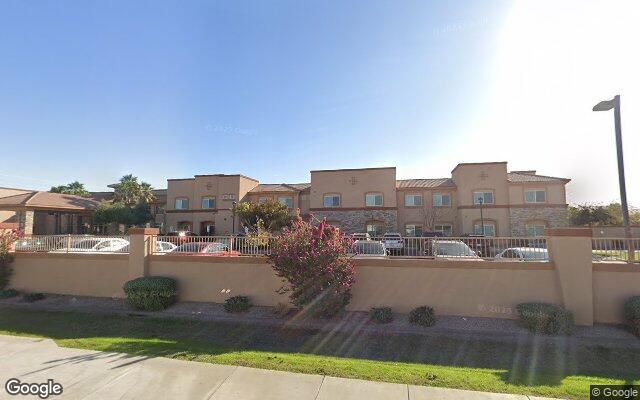
A large home, reviewed on public record.
© Google Street View
Compared to 116 Arizona facilities with a similar number of beds.
Care · 36-month window. Higher percentile = better performance on inspection record. Source: Arizona Dept. of Health Services · Bureau of Residential Facilities Licensing.
among peers to rank.
Rankings based on 36-month ADHS inspection data. Severity and frequency: fewer citations = higher percentile. Repeat rate: lower repeat citation share = higher percentile.
Citation history, plotted month by month.
29 deficiencies on record. Each bar is a month with a citation.
Finding distribution
29 total · 36 monthsScope × Severity (CMS A–L)
Every inspection visit, verbatim.
14 inspections in the public record, most recent first. Plain-language summaries open first — click into any row for the full citation text.
2026-04-02Complaint InvestigationEnforcement · 15 findings
“Based on documentation review, record review, and interview, the governing authority failed to administer a training program for all staff regarding fall prevention and fall recovery, for two of eight sampled staff. The deficient practice posed a risk if a staff member was not properly trained to assist a resident who had fallen and was unable to recover independently. Findings include: 1. A review of facility documentation revealed a policy and procedure (P&P) titled “Staffing and Training Requirements.” The P&P stated: “5. Training Requirements: a. All care staff, including medication staff will be trained in accordance with state regulations. b. All training including orientation, initial training and annual training will be documented in the employee’s file.” The review revealed a P&P titled “Staff Training.” The P&P stated, “Fall prevention and fall recovery trainings will also be done annually.” 2. A review of facility documentation revealed a series of personnel schedules which indicated the following: - E9 worked several shifts per week between April 3, 2025, and the dates of the inspection; - E10 trained on July 22-24 and 29, 2025, then worked on July 31, 2026, and August 1, 4-6, 8-9, 11-21, and 24, 2025; and - E10 did not work on August 25, 2025. 3. A review of E9’s personnel record revealed E9 was hired as a caregiver on February 27, 2023. The review revealed E9 received training regarding fall prevention and fall recovery on December 14, 2024. However, the review revealed no documentation of annual training regarding fall prevention and fall recovery after December 14, 2024. 4. In an interview, E1 reported E9 did not receive training regarding fall prevention and fall recovery in 2025. 5. A review of E10’s personnel record revealed E10 was hired as a caregiver on July 22, 2025. However, the review revealed E10 did not receive training regarding fall prevention and fall recovery until August 25, 2025, more than one month later. 6. In an interview, E1 acknowledged E10 worked for more than one month before receiving training regarding fall prevention and fall recovery. 7. In the exit interview, the Compliance Officer reviewed the findings with E1, and E1 offered no further comment.”
“Based on documentation review, record review, and interview, the manager failed to ensure policies and procedures were established, documented, and implemented to protect the health and safety of a resident that covered cardiopulmonary resuscitation (CPR) training for applicable employees and volunteers, including all items required by this rule. The deficient practice posed a risk as policies and procedures reinforce and clarify standards expected of employees. Findings include: 1. A review of facility documentation revealed a policy and procedure (P&P) titled “CPR and First Aid Policy.” The P&P stated: “CPR certification must be obtained through an organization recognized by the Arizona Department of Health Services (ADHS), such as: American Heart Association, American Red Cross, [and] National Safety Council.” However, the P&P did not include the content of CPR training, the qualifications for an individual to provide cardiopulmonary resuscitation training, or the time-frame for renewal of CPR training. 2. A review of E5’s, E6’s, E8’s, and E9’s personnel records revealed E5, E6, E8, and E9 were hired as caregivers. However, the review revealed E5’s, E6’s, E8’s, and E9’s CPR training certifications were issued by HSI and not by one of the three organizations listed in the P&P. 3. A review of E11’s personnel record revealed E11 was hired as a caregiver. However, the review revealed E11’s CPR training certification was issued by NationalCPRFoundation and not by one of the three organizations listed in the P&P. NationalCPRFoundation CPR training is online-only, with no demonstration of the person’s ability to perform CPR, and is therefore not valid. 4. In the exit interview, the Compliance Officer reviewed the findings with E1, and E1 offered no comment. Technical assistance was provided on this rule during the complaint and compliance inspection conducted on August 5-6, 2024.”
“Based on interview and documentation review, the manager failed to ensure policies and procedures were established and documented to protect the health and safety of a resident to cover methods by which the assisted living facility was aware of the general or specific whereabouts of a resident, based on the level of assisted living services provided to the resident and the assisted living services the assisted living facility was authorized to provide. The deficient practice posed a risk as policies and procedures reinforce and clarify standards expected of employees. Findings include: 1. In an interview, the Compliance Officer requested the facility’s policy and procedure (P&P) covering this rule. E1 reported having a few P&Ps that may cover the rule. 2. A review of facility documentation revealed P&Ps titled “Resident Sign-In / Sign-Out,” “Service Plans,” and “Monitoring Residents.” However, the review revealed these P&Ps were not based on the level of assisted living services provided to the residents and the assisted living services the assisted living facility was authorized to provide. The review revealed no P&P in compliance with this rule. 3. In the exit interview, the Compliance Officer reviewed the findings with E1, and E1 offered no further comment. This is a repeat citation from the complaint inspection conducted on October 10, 2024.”
“Based on documentation review and interview, after having a reasonable basis to believe exploitation had occurred on the premises, the manager failed to report the suspected exploitation of a resident according to Arizona Revised Statutes (A.R.S.) § 46-454; initiate an investigation of the suspected abuse, neglect, or exploitation; and document the items required by this rule. The deficient practice posed a risk to the physical health and safety of a resident. Findings include: 1. A.R.S. § 46-454(A) states: "A health professional...or other person who has responsibility for the care of a vulnerable adult and who has a reasonable basis to believe that abuse, neglect or exploitation of the vulnerable adult has occurred shall immediately report or cause reports to be made of such reasonable basis to a peace officer or to the adult protective services central intake unit...The reports required by this subsection shall be made immediately by telephone or online." 2. Arizona Administrative Code R9-10-101(111) states, "'Immediate' means without delay." 3. In an interview, E14 reported that E14 visited the facility on March 5, 2026, and heard about an incident of suspected exploitation in October 2025 involving R8 and E13. E14 reported that E14 learned about the suspected exploitation the morning of March 5, 2026, and called the assigned police investigator later that day. E14 mentioned that E14 reported the suspected exploitation to Adult Protective Services (APS) the next day, March 6, 2026. E14 reported that the previous manager learned about the suspected exploitation in late 2025. E14 reported believing the previous manager reported it to APS upon learning about it. When the Compliance Officer asked if the facility had any documentation of the original report to APS, the original investigation report, or any other documentation regarding the original suspected exploitation, E14 stated, “No.” E14 reported that E14 could provide said documentation for the report E14 made. 4. A review of facility documentation revealed an untitled document detailing suspected exploitation of R8 by E13. However, the document did not include the dates and times of the suspected exploitation, other than “October 2025.” The document further stated: “Voicemail was left for APS on 3/6/202[6] at approximately 0900. This RN also called [the detective] and connected with [the detective] voice to voice at approximately 1310 on 3/6/26.” 5. In an interview, E14 acknowledged that E14 did not report the suspected exploitation immediately. 6. In the exit interview, the Compliance Officer reviewed the findings with E1, and E1 offered no further comment. This is a repeat citation from the complaint and compliance inspection conducted on August 5-6, 2024.”
“Based on documentation review, record review, and interview, the manager failed to ensure a caregiver provided evidence of freedom from infectious tuberculosis (TB) on or before the date the individual began providing services at or on behalf of the assisted living facility as specified in Arizona Administrative Code (A.A.C.) R9-10-113, for two of seven sampled caregivers. The deficient practice posed a potential TB exposure risk to residents. Findings include: 1. R9-10-113(A)(2)(a)(i-iii) and (b)(ii) states: "If a health care institution is subject to the requirements of this Section, as specified in an Article in this Chapter, the health care institution's chief administrative officer shall ensure that the health care institution establishes, documents, and implements tuberculosis infection control activities that...2. Include: a. For each individual who is employed by the health care institution…and who is subject to the requirements of this Section, screening, on or before the date specified in the applicable Article of this Chapter, that consists of i. Assessing risks of prior exposure to infectious tuberculosis, ii. Determining if the individual has signs or symptoms of tuberculosis, and iii. Obtaining documentation of the individual's freedom from infectious tuberculosis according to subsection (B)(1); b. If an individual may have a latent tuberculosis infection, as defined in A.A.C. R9-6-1201…ii. Annually obtaining documentation of the individual’s freedom from symptoms of infectious tuberculosis, signed by a medical practitioner, occupation health provider, as defined in A.A.C. R9-6-801, or local health agency, as defined in A.A.C. R9-6-101.” 2. R9-10-113(B)(1)(a)(i) states: "B. A health care institution's chief administrative officer shall: 1. For an individual for whom baseline screening and documentation of freedom from infectious tuberculosis is required by an Article in this Chapter, as specified in subsection (A)(2)(a), obtain one of the following as evidence of freedom from infectious tuberculosis: a. Documentation of a negative Mantoux skin test or other tuberculosis screening test that: i. Is recommended by the U.S. Centers for Disease Control and Prevention (CDC)." 3. A review of the CDC website revealed a web page titled "Baseline Tuberculosis Screening and Testing for Health Care Personnel." The web page stated: "If the Mantoux tuberculin skin test (TST) is used for baseline testing of health care personnel, use two-step testing. Purpose: Two-step testing is recommended for the initial TB skin test for adults who may be tested periodically, such as health care personnel.” 4. A review of E8’s personnel record revealed E8 was hired as a caregiver on February 9, 2024. The review revealed a positive TST dated before E8 began providing services at the facility. However, the review revealed no annual documentation of E8’s freedom from symptoms of infectious TB, signed by a medical practitioner, occupational health provider, or local health agency. 5. A review of E10’s personnel record revealed E10 was hired as a caregiver on July 22, 2025. The review revealed documentation of one negative TST dated as read within one year before E10 began providing services at the facility and one negative TST dated as read after E10 began providing services at the facility. The review further revealed documentation of assessing risks of prior exposure to infectious TB and determining if E10 had signs or symptoms of TB, also dated after E10 began providing services at the facility. 6. A review of facility documentation revealed a series of personnel schedules that indicated E8 worked several shifts per week between April 3, 2025, and the dates of the inspection. The schedule further revealed E10 worked before E10’s second negative TST was read and before E10’s risk assessment and signs and symptoms screening were completed. 7. A review of R2’s, R3’s, R4’s, and R5’s medical records revealed documentation of assisted living services (ADLs) provided to the five residents as well as medication administration records (MARs) dated March 2026. The ADLs and MARs revealed that E8 and E10 provided services to the five residents in March 2026, without the required TB documentation. 8. In an interview, E1 acknowledged E8 and E10 worked without the required TB documentation. 9. In the exit interview, the Compliance Officer reviewed the findings with E1, and E1 offered no further comment. Technical assistance was provided on this rule during the complaint inspection conducted on November 19, 2025, and the complaint and compliance inspection conducted on August 5-6, 2024.”
“Based on documentation review, record review, and interview, the manager failed to ensure a caregiver provided current documentation of first aid (FA) training and cardiopulmonary resuscitation (CPR) training certification specific to adults before providing assisted living services to a resident, for two of seven sampled caregivers. The deficient practice posed a risk if a caregiver was unable to meet a resident's needs during an emergency. Findings include: 1. A review of facility documentation revealed a policy and procedure (P&P) titled “Staffing and Training Requirements.” The P&P stated: “6. Each Community must have at least one (1) staff member trained in CPR and First Aid on duty and on the premises at all times. a. All care staff will be trained in CPR and First Aid.” 2. A review of facility documentation revealed a series of personnel schedules which indicated E10 worked multiple shifts each week between August 31, 2025, and October 6, 2025, and E11 worked multiple shifts each week between January 15, 2026, and the dates of the inspection. 3. A review of E10’s personnel record revealed E10 was hired as a caregiver. The review revealed a photocopied picture of a FA and CPR training certificate dated as expired on August 30, 2025, as well as a printout of a FA and CPR training card dated as issued on October 7, 2025. However, the review revealed E10 did not have valid FA and CPR certification training between August 31, 2025, and October 6, 2025. 4. In an interview, E1 reported not having documentation of FA and CPR certification training between August 31, 2025, and October 6, 2025, for E10. 5. A review of E11’s personnel record revealed E11 was hired as a caregiver. The review revealed a photocopied picture of a FA and CPR training card dated as expired on January 14, 2026, as well as a photocopied picture of a FA and CPR training certificate dated as issued by NationalCPRFoundation on February 6, 2026. The review revealed no other FA and CPR training certification. The review revealed E11 did not have valid FA certification training between January 15, 2026, and February 5, 2026, and E11 did not have valid CPR certification training between January 15, 2026, and the dates of the inspection. 6. A review of the NationalCPRFoundation website revealed E11's CPR training was online-only and did not include a demonstration of E11's ability to perform CPR as required by rule. 7. In an interview, E1 stated, “[E11] still needs another CPR.” 8. In the exit interview, the Compliance Officer reviewed the findings with E1, and E1 offered no further comment. This is a repeat citation from the complaint and compliance inspection conducted on August 5-6, 2024.”
“Based on documentation review, record review, and interview, the manager failed to ensure that a resident provided evidence of freedom from infectious tuberculosis (TB) before or within seven calendar days after the resident's date of occupancy and as specified in R9-10-113, for five of eight sampled residents. The deficient practice posed a TB exposure risk to residents. Findings include: 1. R9-10-113(A)(2)(a)(i-iii) states: "A. If a health care institution is subject to the requirements of this Section, as specified in an Article in this Chapter, the health care institution's chief administrative officer shall ensure that the health care institution establishes, documents, and implements tuberculosis infection control activities that...2. Include: a. For each individual who is…admitted to the health care institution and who is subject to the requirements of this Section, screening, on or before the date specified in the applicable Article of this Chapter, that consists of: i. Assessing risks of prior exposure to infectious tuberculosis, ii. Determining if the individual has signs or symptoms of tuberculosis, and iii. Obtaining documentation of the individual's freedom from infectious tuberculosis according to subsection (B)(1)." 2. A review of R1's, R3’s, and R5’s medical records revealed R1, R3, and R5 were admitted to the assisted living facility more than seven days prior to the dates of the inspection. However, the review revealed no documentation of assessing risks of prior exposure to infectious TB or determining if R1, R3, and R5 had signs or symptoms of TB. 3. A review of R4's and R6’s medical records revealed R4 and R6 were admitted to the assisted living facility more than seven days prior to the dates of the inspection. However, the review revealed no documentation of assessing risks of prior exposure to infectious TB, determining if R4 and R6 had signs or symptoms of TB, or negative TB test(s). 4. In an interview, E1 reported not having the aforementioned documentation for R1, R3, R4, R5, and R6. 5. In the exit interview, the Compliance Officer reviewed the findings with E1, and E1 offered no further comment. Technical assistance was provided on this rule during the complaint inspection conducted on November 19, 2025, and the complaint and compliance inspection conducted on August 5-6, 2024.”
“Based on interview and record review, the manager failed to ensure a caregiver or an assistant caregiver documented the services provided to a resident in the resident's medical record, for three of eight sampled residents. The deficient practice posed a risk as services could not be verified as provided against a service plan. Findings include: 1. In an interview, E2 reported the overnight [NOC] shift was from 10:00 PM to 6:00 AM. 2. A review of R3’s medical medical revealed a service plan dated January 24, 2026. The service plan revealed R3 was to receive assistance with several services during the NOC shift, including wellness checks, incontinence care, urinary tract infection observations, hydration care, orientation impairment care, memory impairment care, and behavioral care. The review revealed documentation of assisted living services (ADLs) provided to R3 in March 2026. However, the ADLs revealed no services were documented as provided on the March 20, 2026, NOC shift. 3. In an interview, when the Compliance Officer asked if R3 had been out of the facility during the March 20, 2026, NOC shift, E1 stated, “I don’t see that [R3] was on leave those dates.” E1 further stated the caregivers "probably just didn’t chart that day.” 4. A review of R4’s medical medical revealed ADLs dated March 2026. The ADLs stated R4 was “On Leave” on March 21-23, 2026, leaving before 2:00 PM on March 21, 2026, and returning before 2:00 PM on March 23, 2026. However, the ADLs indicated R4 received services at 10:00 PM on March 21, 2026, and at 6:00 AM on March 22, 2026, even though R4 was not present at the facility. 5. In an interview, E1 reported R4 was on leave with R4’s family member between 1:00 PM on March 21, 2026, and 10:30 AM on March 23, 2026. E1 reported the ADLs were documented by mistake. 6. A review of R5’s medical medical revealed a service plan dated January 6, 2026. The service plan revealed R5 was to receive assistance with several services during the NOC shift, including wellness checks, incontinence care, hydration care, orientation impairment care, memory impairment care, mobility, and transferring. The review revealed ADLs dated March 2026. However, the ADLs revealed no services were documented as provided on the March 20, 2026, NOC shift. 7. In the exit interview, the Compliance Officer reviewed the findings with E1, and E1 offered no further comment. Technical assistance was provided on this rule during the complaint inspection conducted on November 22-25, 2024.”
“Based on interview and documentation review, the manager failed to ensure a resident was not subjected to misappropriation of personal and private property by the assisted living facility’s employees. The deficient practice posed a risk as approximately $7500.00 was taken from a resident’s bank account without the resident’s knowledge or permission. Findings include: 1. In an interview, E14 reported E14 visited the facility on March 5, 2026, and heard about an incident of suspected exploitation in October 2025 involving R8 and E13. E14 reported E14 learned about the suspected exploitation the morning of March 5, 2026, and called the assigned police investigator later that day. E14 reported the previous manager learned about the suspected exploitation in late 2025. 2. A review of facility documentation revealed an untitled document detailing suspected exploitation of R8 by E13. The document stated: “ On Thursday March 5th this RN was visiting MorningStar of Golden Ridge when the Ops Specialist, [E15] informed me that there was an active police investigation involving [E15], our current Wellness Director. [E2], Business Office Manager then came in to relay the events. It was reported to me that back in October 2025 there was an incident involving a previous resident [R8]. [R8] asked [E13] to go to pick up [R8’s] meds with [R8’s] bank or credit card. It was revealed through this conversation that [E13] also asked for [R8’s] pin number. [R8] came forward to the previous [manager] to report a theft back in October. [E13] was interviewed by the RN, [E15] and [E2] again on 3/5/2026. [E13] reported that [E13] did in fact take [R8’s] credit card to pick up medications. [E13] brought down documents that included a fax cover sheet for Salibas Pharmacy. The fax cover sheet had a note typed in that a $400 money order was sent to the pharmacy for payment. [E13] admitted that [E13] shouldn’t have taken the card to pick up medications for [R8]. [E13] said that [R8] asked others to take [R8’s] card and shop for [R8] often. [E13] stated that [E13] held trainings with the teams after this event to inform [the teams] that [the teams] are not allowed to take resident cards and shop for [the residents]. This RN asked for a written statement from [E13] and as of the time of this note 3/6/26 at 1610 no statement has been received. This RN also asked for copies of the documentation that [E13] had and still have not received that. This RN spoke to [owner] of Salibas pharmacy on 3/5/2026 at approximately 1800 and [owner] stated that from what [owner] could see there was never a $400 credit to the account…[E13] reported during this interview that APS had already been out and investigated these concerns and stated that [the concerns] were found to be ‘unfounded’. This RN asked for documentation and as of this date no documentation has been provided. [E13] was called and informed on 3/6/2026 at approximately 10:00 that [E13] was being placed on admin leave. This RN again asked for written documentation and still have not received it.” 3. In an interview, E14 reported E14 later found out there was a total of approximately $7500.00 taken from R8’s account without R8’s knowledge or permission. 4. In the exit interview, the Compliance Officer reviewed the findings with E1, and E1 offered no further comment.”
“Based on observation and interview, the manager failed to ensure a resident's medical record was protected from loss, damage, or unauthorized use. The deficient practice posed a risk of protected sensitive resident health information being disclosed without the resident's consent or knowledge. Findings include: 1. The Compliance Officer observed an unattended medication cart in a common hallway. On the medication cart, the Compliance Officer observed a laptop. Upon opening the laptop and clicking on an icon, the Compliance Officer observed resident medical records. 2. In an interview, speaking to E12, E1 stated, “Your computer was unlocked.” E12 confirmed the computer was unlocked and E1 reported it should not have been. 3. In the exit interview, the Compliance Officer reviewed the findings with E1, and E1 offered no further comment. Technical assistance was provided on this rule during the complaint and compliance inspection conducted on August 5-6, 2024.”
“Based on record review and interview, the manager failed to ensure a resident’s medical record contained documentation of assisted living services provided to the resident, for one of eight sampled residents. The deficient practice posed a risk as services could not be verified as provided against a service plan Findings include: 1. A review of R6’s medical medical revealed a service plan dated March 22, 2026. The service plan revealed R6 was to receive assistance with several services between twelve times per day and two times per week, including bathing, dressing, incontinence care, nail care, and wellness checks, among others. However, the review revealed no documentation of assisted living services (ADLs) provided to R6 in March 2026 or April 2026. 2. In an interview, E1 reported there was an issue with the system not causing the services on the service plan to populate on the ADLs. E1 reported R6 did not have ADLs for March 2026 and April 2026 for this reason. 3. In the exit interview, the Compliance Officer reviewed the findings with E1, and E1 offered no further comment. Technical assistance was provided on this rule during the complaint inspection conducted on November 22-25, 2024.”
“Based on documentation review, observation, and interview, the manager failed to ensure a means of exiting the facility for a resident who did not have a key, special knowledge for egress, or the ability to expend increased physical effort that monitored or alerted employees of the egress of a resident from the facility. The deficient practice posed a risk if the facility was unaware of the egress of a resident from the facility. Findings include: 1. A review of Department documentation revealed the facility was authorized to provide directed care services. 2. The Compliance Officer observed three doors leading from common areas of the memory care section of the facility and one from unit 1109 in the memory care section to an outdoor courtyard area that allowed residents to be at least 30 feet from the facility. The Compliance Officer observed the doors had alerts installed. However, the alerts did not sound when the Compliance Officer opened them. The Compliance Officer further observed no monitoring system in place. 3. In an interview, E1 reported the alerts sent messages to the phones of the caregivers when the doors were opened. However, when the Compliance Officer opened two of the doors in one of the common areas, E3 reported not receiving messages, stating, “I got nothing.” When the Compliance Officer opened the third door in another common area, E3 stated E3 received “No alarm.” When the Compliance Officer opened the door in unit 1109, E3 stated “I don’t have this one.” 4. In the exit interview, the Compliance Officer reviewed the findings with E1, and E1 offered no further comment.”
“Based on record review and interview, the manager failed to ensure a medication was administered in compliance with a medication order, for one of eight sampled residents. The deficient practice posed a risk if the resident experienced a change in condition due to improper administration of medication. Findings include: 1. A review of R4’s medical record revealed a current service plan which indicated R4 received medication administration. The review revealed a medication order for “Seroquel [quetiapine] 25 mg oral tablet…1 tab Oral Daily” dated February 11, 2026. The review further revealed a medication administration record (MAR) dated March 2026. However, the MAR revealed R4 did not receive R4’s quetiapine on March 15, 2026, as the “Medication [was] not available.” 2. In an interview, E1 acknowledged R4’s quetiapine was not administered as ordered. 3. In the exit interview, the Compliance Officer reviewed the findings with E1, and E1 offered no further comment. This is a repeat citation from the complaint inspection conducted on May 20, 2025; an uncorrected citation from the complaint inspection conducted on December 12, 2024; and a repeat citation from the complaint inspections conducted on November 22-25, 2024, and September 13, 2024.”
“Based on documentation review and interview, the manager failed to ensure a disaster drill for employees was conducted on each shift at least once every three months and documented. The deficient practice posed a risk if employees were unable to implement a disaster plan. Findings include: 1. A review of facility documentation revealed no documentation of disaster drills for employees dated within the last year. 2. In an interview, E1 confirmed E1 did not have documentation of any disaster drills for employees dated within the last year. 3. In the exit interview, the Compliance Officer reviewed the findings with E1, and E1 offered no further comment.”
“Based on documentation review and interview, the manager failed to ensure an evacuation drill for employees and residents was conducted at least once every six months. The deficient practice posed a risk if employees were unable to implement a disaster plan and safely evacuate residents during an emergency. Findings include: 1. A review of facility documentation revealed no documentation of evacuation drills for employees and residents dated within the last year. 2. In an interview, E1 confirmed E1 did not have documentation of any evacuation drills for employees and residents dated within the last year. 3. In the exit interview, the Compliance Officer reviewed the findings with E1, and E1 offered no further comment. Technical assistance was provided on this rule during the complaint and compliance inspection conducted on August 5-6, 2024.”
2025-11-19Complaint InvestigationR9-10-806.C.1 · 1 finding
“Based on record review and interview, the manager failed to ensure a personnel record for each employee included documentation of cardiopulmonary resuscitation (CPR) training and first aid training, for one of three employees sampled. Findings include: 1. A review of E3’s personnel record revealed E3 was hired as the Assisted Living Coordinator. The review revealed documentation of CPR and first aid training dated as expired on July 18, 2025, and documentation of CPR and first aid training dated as issued on September 17, 2025. However, the review revealed no documentation of CPR and first aid training dated between July 18, 2025, and September 17, 2025. 2. In an interview, E1 stated E3 “sometimes” worked the floor as a caregiver. When the Compliance Officer asked if E3’s personnel record had documentation of CPR and first aid training dated between the aforementioned dates, E1 stated, “I’m sure there’s nothing there.” 3. In an interview, E3 reported E3 had completed CPR and first aid training for another job but did not have the certification in E3’s personnel record. Technical assistance was provided on this rule during the complaint and compliance inspection conducted on February 1, 2023.”
2025-07-16Other VisitNo findings
2025-06-19Complaint InvestigationA.A.C. · 1 finding
“Based on record review and interview, the health care institution failed to initiate cardiopulmonary resuscitation (CPR) in accordance with its certification training for CPR before the arrival of emergency medical services, to a resident who was nonresponsive or has a cessation of normal respiration, in accordance with that resident's advance directives, if known. The deficient practice posed a risk to the physical health and safety of a resident. Findings include: 1. A review of R1’s medical record revealed a document titled “Resident Information”. This document, stated in the Advance Directive section, “CPR”. 2. A record review revealed a document titled “Incident Report” dated May 25, 2025. The incident report indicated that neither E2 nor E3 administered CPR when R1 was found on the floor, unresponsive, and without a pulse. The document reported that 911 was called. 3. In an interview, E1 acknowledged CPR was not initiated by the caregivers and stated that “when E3 called 911, E3 was instructed not to do CPR because of the condition of the resident”.”
2025-06-12Complaint InvestigationNo findings
2025-05-20Complaint InvestigationR9-10-806.A.4 · 2 findings
“Based on documentation review, record review, and interview, the manager failed to ensure a caregiver's skills and knowledge were verified and documented before the caregiver provided physical health services, for four of four sampled caregivers. The deficient practice posed a risk if a caregiver did not have the skills and knowledge necessary to meet a resident's needs and the Department was provided false or misleading information. Findings include: 1. A review of Department documentation revealed a Plan of Correction (POC) for this deficiency from the complaint and compliance inspection conducted on August 6, 2024. The POC indicated this deficiency was corrected on March 7, 2025. The POC stated: “Community now has a Policy and Procedure that designates how a caregiver’s skill and knowledge will be verified. All caregivers’ and assistant caregiver’s skills and knowledge have now been verified and documented according to the Policy and Procedure.” 2. A review of facility documentation revealed a policy and procedure (P&P) titled “New Hire Training and Competency Policy” dated March 1, 2025. The P&P stated: “A competency checklist will be used and completed upon hire and for retraining. All checklists will be reviewed and verified by the Business Officer Manager/Executive Director or designee to ensure compliance, and stored in their personnel file. The assessment/evaluation may include skills, tasks or competencies identified in the associate’s job description (i.e., bathing, handwashing, ambulation, transfer, etc.).” 3. A review of E3's, E4’s, and E6’s personnel records revealed E3, E4, and E6 were hired as caregivers before March 7, 2025 (the correction date on the POC). However, the review revealed no documentation demonstrating the manager ensured E3's, E4’s, and E6’s skills and knowledge were verified and documented before E3, E4, and E6 provided physical health services or before the correction date on the POC. 4. A review of E5's personnel record revealed E5 was hired as a caregiver after March 7, 2025 (the correction date on the POC). However, the review revealed no documentation demonstrating the manager ensured E5's skills and knowledge were verified and documented before E5 provided physical health services. 5. A review of facility documentation revealed a series of personnel schedules dated between November 2024 and May 2025. The schedules revealed E3, E4, E5, and E6 provided physical health services without E3’s, E4’s, E5’s, and E6’s skills and knowledge having first been verified and documented. 6. In an interview, E2 stated, “[E4’s] is incomplete.” When the Compliance Officer asked if E5 did not have documentation of E5’s skills and knowledge, E2 stated, “Yeah, I did not find one.” When the Compliance Officer asked about the same documentation for E3 and E6, E2 stated, “I don’t have one for any of them.” This is a repeat citation from the complaint and compliance inspection conducted on August 6, 2024.”
“Based on record review and interview, the manager failed to ensure medication administered to a resident was administered in compliance with a medication order, for two of three sampled residents. The deficient practice posed a risk if a resident experienced a change in condition due to improper administration of medication. Findings include: 1. A review of R1’s medical record revealed a service plan which indicated R1 received medication administration. The review revealed a medication order dated April 1, 2025, for the following medications: - “OLANZAPINE 5 MG TABLET…TAKE 1 TABLET BY MOUTH DAILY AT BEDTIME;” - “OLMESARTAN MEDOXOMIL 40 MG TAB…TAKE 1 TABLET BY MOUTH DAILY;” - “PAROXETINE HCL 40 MG TABLET…TAKE 1 TABLET BY MOUTH DAILY;” - “QUETIAPINE FUMARATE 25 MG TAB…TAKE 1 TABLET BY MOUTH AT BEDTIME;” - “STIMULANT LAXATIVE PLUS TABLET…TAKE 2 TABLETS BY MOUTH DAILY AT BEDTIME;” and - “TRAZODONE 50 MG TABLET…TAKE 1 TABLET BY MOUTH DAILY AT BEDTIME.” The review revealed a series of medication administration records (MAR) dated April 2025 and May 2025 which indicated the following: - R1 did not receive olanzapine on April 7-8 and 10, 2025, as the “Medication [was] not available;” - R1 did not receive olmesartan on May 4, 2025, as the “Medication [was] not available;” - R1 did not receive paroxetine on May 4, 2025, as the “Medication [was] not available;” - R1 did not receive quetiapine on April 6-8 and 10, 2025, and May 19, 2025, as the “Medication [was] not available;” - R1 did not receive Stimulant Laxative Plus on April 17, 28, and 30, 2025, and May 2-3 and 13, 2025, as the “Medication [was] not available;” and - R1 did not receive trazodone on April 30, 2025, and May 1-2 and 11-12, 2025, as the “Medication [was] not available.” 2. A review of R3’s medical record revealed a service plan which indicated R3 received medication administration. The review revealed a medication order dated April 15, 2025, for “dorzolamide 22.3 mg-timoloL 6.6 mg/mL eye drops INSTILL 1 DROP INTO AFFECTED EYE(S) TWICE DAILY” and “latanoprost 0.005 % eye drops INSTILL 1 DROP INTO BOTH EYES AT BEDTIME.” The review revealed MARs dated April 2025 and May 2025 which indicated R3 did not receive R3’s second dose of dorzolamide on April 26, 2025, and R3’s latanoprost on May 11, 2025, as both “Medication[s were] not available.” 3. In an interview, E1 acknowledged medications administered to R1 and R3 were not administered in compliance with medication orders, stating there were, “Holes in the MAR.” This is an uncorrected deficiency from the complaint inspections conducted on December 12, 2024; November 25, 2024; and September 13, 2024; and no acceptable plans of correction have been received by the Department.”
2025-04-01Complaint InvestigationNo findings
2025-03-17Complaint InvestigationA.A.C. · 1 finding
“A. A governing authority shall: 3. Designate, in writing, a manager who: b. Except for the manager of an adult foster care home, has either a: i. Certificate as an assisted living facility manager issued under A.R.S. § 36-446.04(C), or ii. A temporary certificate as an assisted living facility manager issued under A.R.S. § 36-446.06;”
2025-02-06Complaint InvestigationA.A.C. · 1 finding
“Based on documentation review, observation and interview, the governing authority failed to designate, in writing, a manager who has either a certificate as an assisted living facility manager issued under A.R.S. \'a7 36-446.04(C), or a temporary certificate as an assisted living facility manager issued under A.R.S. \'a7 36-446.06. The deficient practice posed a risk as the assisted living facility was unable to ensure compliance with applicable Rules. Findings include: 1. A review of Department documentation on January 4, 2025, revealed that O1 notified the Department O1 would no longer serve as the Assisted Living Manager at "AL11067 MorningStar at Golden Ridge" effective January 8, 2024. 2. A review of Department documentation revealed E1 notified the Department on January 14, 2025 that E1 would serve as "interim executive director". However, a review of the Board of Examiners for Nursing Care Institution Administrators and Assisted Living Facility Managers (NCIA Board) website revealed no managers certificate for E1. 3. The Compliance Officer observed that an assisted living facility manager certificate was not conspicuously posted in the facility during a complaint investigation conducted on February 06, 2025. 4. In a telephone interview, O1 reported O1 removed O1's license on January 8, 2024, and the facility has had no manager since. 5. In an interview, E3 and E4 reported the facility did not currently have a certified manager. E3 and E4 acknowledged the facility did not designate in writing a manager who either had a certificate as an assisted living facility manager issued under A.R.S. \'a7 36-446.04(C), or a temporary certificate as an assisted living facility manager issued under A.R.S. \'a7 36-446.06.”
2024-11-22Complaint InvestigationA.A.C. · 2 findings
“Based on record review and interview, the manager failed to ensure medication administered to a resident was administered in compliance with a medication order, for three of four sampled residents. The deficient practice posed a risk if a resident experienced a change in condition due to improper administration of medication. Findings include: 1. A review of R1's medical record revealed a current service plan which indicated R1 was to receive medication administration. The review revealed a medication order for "mesalamine PO 400 mg...2 caps twice daily" and "rivastigmine patch transdermal 9.5 mg...apply 1 patch daily"dated July 8, 2024. The review further revealed two medication administration records (MARs) dated September 2024 and October 2024. The MARS revealed the following: - R1 did not receive R1's second dose of mesalamine on September 11-12, 2024, due to the "Medication not [being] available;" - R1 did not receive R1's rivastigmine on October 25 and 28-30, 2024, due to the "Medication not [being] available;"and - R1 received ciclopirox 8% solution nearly every day between September 1, 2024, and November 21, 2024, without a medication order. 2. A review of R3's medical record revealed a current service plan which indicated R3 was to receive medication administration. The review revealed a medication order for "HYDROCORTISONE 1 % CREAM APPLY TOPICALLY TWICE DAILY" with a start date of January 12, 2023. The review further revealed a MAR dated November 2024 which indicated R3 did not receive R3's first dose of hydrocortisone cream on November 1 and 21, 2024. 3. A review of R4's medical record revealed a current service plan which indicated R4 was to receive medication administration. The review revealed medication orders for "levetiracetam (500mg/5mL) 10mL BID PO" dated March 4, 2024, and "Atenolol 25 mg Tab TAKE 1 TABLET BY MOUTH EVERY NIGHT AT BEDTIME" dated October 11, 2024. The review further revealed MARs dated September-November 2024. The MARS revealed the following: - R4 did not receive R4's first dose of levetiracetam on September 21, 2024, due to the "Medication not [being] available;" - R4 did not receive R4's second dose of levetiracetam on September 20-21, 2024, due to the "Medication not [being] available;" - R4 did not receive R4's atenolol on October 29 and 31, 2024, due to the "Medication not [being] available;"and - R4 did not receive R4's atenolol on November 17-18, 2024. 4. In an interview, E2 reported having an order to hold R4's atenolol on November 17-18, 2024. 5. A review of R4's medical record revealed an order to hold R4's atenolol on November 17-18, 2024, "due to pharmacy issue." However, the order was dated November 23, 2024, the day after the first day of the inspection and several days after the medication was not administered. 6. In an interview, E1 acknowledged medication administered to R1, R3, and R4 were not administered in compliance with the corresponding medication orders. This is an uncorrected citation from the complaint inspection conducted on September 13, 2024.”
“Based on observation and interview, the manager failed to ensure garbage and refuse were stored in covered containers. The deficient practice posed a risk to the health and safety of the residents as an uncovered garbage container can lead to the possibility of infection. Findings include: 1. During the environmental inspections of the facility conducted on November 22, 2024, and November 25, 2024, the Compliance Officer observed garbage in uncovered containers lined with plastic bags in R4's bedroom, in an upstairs conference room, and in an upstairs common bathroom. 2. In an interview, E1 reported the containers should have had covers. Technical assistance was provided on this rule during the complaint and compliance inspection conducted on August 5-6, 2024.”
2024-09-26Complaint InvestigationNo findings
2024-09-13Complaint InvestigationA.A.C. · 1 finding
“Based on record review and interview, the manager failed to ensure medication administered to a resident was administered in compliance with a medication order, for one of four sampled residents. The deficient practice posed a risk if a resident experienced a change in condition due to improper administration of medication. Findings include: 1. A review of R2's medical record revealed a current service plan which indicated R2 was to receive medication administration. The review revealed a medication order for "STIMULANT LAXATIVE PLUS TABLET TAKE 1 TABLET BY MOUTH TWICE DAILY *HOLD FOR LOOSE STOOLS* [at 8:00 AM and 8:00 PM]" dated August 24, 2024, and a medication order for "STIMULANT LAXATIVE PLUS TABLET TAKE 1 TABLET BY MOUTH TWICE DAILY [at 8:00 AM and 5:00 PM]," dated August 30, 2024. The review further revealed two medication administration records (MAR) dated August 2024 and September 2024. The MARS revealed the following: - R2 did not receive "STIMULANT LAXATIVE PLUS TABLET TAKE 1 TABLET BY MOUTH TWICE DAILY *HOLD FOR LOOSE STOOLS* [at 8:00 AM and 8:00 PM]" at 8:00 AM on August 27-30, 2024, and due to the "Medication not [being] available;" - R2 did not receive "STIMULANT LAXATIVE PLUS TABLET TAKE 1 TABLET BY MOUTH TWICE DAILY *HOLD FOR LOOSE STOOLS* [at 8:00 AM and 8:00 PM]" at 8:00 PM on August 25-28 and 30, 2024, and September 1-3, 2024, due to the "Medication not [being] available;" and - R2 did not receive "STIMULANT LAXATIVE PLUS TABLET TAKE 1 TABLET BY MOUTH TWICE DAILY [at 8:00 AM and 5:00 PM]" at 5:00 PM on September 1-3 , 2024, due to the "Medication not [being] available." 2. In an interview, when the Compliance Officer asked if R2's laxatives had been unavailable to administer at the aforementioned times and dates, E3 stated, "Yes." E3 reported R2's family was to provide the laxatives.”
2024-08-05Complaint InvestigationA.A.C. · 5 findings
“Based on interview and documentation review, the manager failed to ensure documentation required by this Article was provided to the Department within two hours after a Department request. Findings include: 1. In an interview conducted at approximately 9:40 AM on August 5, 2024, the Compliance Officer requested personnel schedules dated August 2023 through August 2024. 2. A review of facility documentation revealed the provided personnel schedules did not cover the following dates: - August 5, 2023, through October 8, 2023; - November 20-30, 2023; - December 23-31, 2023; - January 23-31, 2023; - February 21-29, 2024; - March 23-31, 2024; - May 29-31, 2024; and - June 29-30, 2024. 3. In an interview, E4 reported the facility changed systems in March or April and would have to contact legal to get the missing personnel schedules. 4. During the exit interview conducted at approximately 12:00 PM on August 6, 2024, E1 acknowledged facility personnel did not provide all of the requested personnel schedules within two hours after a Department request. This is a repeat citation from the complaint and compliance inspection conducted on February 1, 2023.”
“Based on documentation review and interview, a manager who had a reasonable basis to believe abuse, neglect, or exploitation occurred on the premises failed to immediately report the suspected abuse, neglect, or exploitation of the resident according to Arizona Revised Statutes (A.R.S.) \'a7 46-454. The deficient practice posed a risk to the health and safety of a resident. Findings include: 1. A.R.S. \'a7 46-454(A) states: "A health professional...or other person who has responsibility for the care of a vulnerable adult and who has a reasonable basis to believe that abuse, neglect or exploitation of the adult has occurred shall immediately report or cause reports to be made of such reasonable basis to a peace officer or to the adult protective services central intake unit...All of the above reports shall be made immediately by telephone or online." 2. Arizona Administrative Code (A.A.C.) R9-10-101(111) states "[i]mmediate" means "without delay." 3. In an interview, E1 mentioned three incidents where E1 had a reasonable basis to believe abuse, neglect, or exploitation occurred on the premises. E1 reported E1 submitted reports regarding each incident to Adult Protective Services (A.P.S.). 4. A review of facility documentation revealed three incident reports and the corresponding reports to A.P.S. However, the incidents were not reported to A.P.S. immediately. The first incident, regarding the suspected abuse of R7, occurred on April 22, 2024, at 5:50 PM and was not reported to A.P.S. until April 23, 2024, at 9:47 AM. The second incident, regarding the suspected abuse of R3, occurred on July 10, 2024, at 7:00 AM and was not reported to A.P.S. until July 10, 2024, at 12:03 PM. The third incident, regarding the suspected abuse of R4, occurred on July 12, 2024, at 8:23 PM and was not reported to A.P.S. until July 13, 2024, at 1:24 PM. 5. In an interview, E1 acknowledged E1 did not immediately report the aforementioned suspected abuse.”
“Based on documentation review, interview, and record review, the manager failed to ensure a caregiver's skills and knowledge were verified and documented before the caregiver provided physical health services and according to policies and procedures, for one of five sampled caregivers. The deficient practice posed a risk if a caregiver did not have the skills and knowledge necessary to meet a resident's needs. Findings include: 1. A review of facility documentation revealed a policy and procedure (P&P) titled "New Hire Training and Competency Policy" dated January 1, 2022. However, the P&P did not include how a caregiver's or assistant caregiver's skills and knowledge verification would be documented. 2. In an interview, E1 reported the aforementioned P&P was the only P&P the facility had covering this rule. 3. A review of E9's personnel record revealed E9 was hired as a caregiver. However, the review revealed E9's skills and knowledge were not verified until approximately two months after E9 was hired. 4. A review of facility documentation revealed a series of personnel schedules which indicated E9 provided physical health services before E9's skills and knowledge were verified. 5. In an interview, E1 confirmed E9 provided physical health services before E9's skills and knowledge were verified.”
“Based on record review, documentation review, and interview, the manager failed to ensure a caregiver provided current documentation of first aid training certification specific to adults before providing assisted living services to a resident, for one of five sampled caregivers. The deficient practice posed a risk if a caregiver was unable to meet a resident's needs during an emergency. Findings include: 1. A review of E8's personnel record revealed E8 was hired as a caregiver. However, the review revealed no documentation of first aid training certification specific to adults. 2. A review of facility documentation revealed a series of personnel schedules which indicated E8 provided assisted living services to residents without having first aid training certification. 3. In an interview, E1 confirmed E8 provided assisted living services to residents without having first aid training certification.”
“Based on observation and interview, the manager failed to ensure medication stored by an assisted living facility was stored in a separate locked room, closet, cabinet, or self-contained unit used only for medication storage. The deficient practice posed a risk to the physical health and safety of residents with access to the medication. Findings include: 1. During the environmental inspection of the facility, the Compliance Officer observed an office in the memory care section of the facility with the door open and no facility personnel within sight. Inside the office, the Compliance Officer observed a large tote of resident medication. 2. In a series of interviews, E1 and E2 reported the office should have been locked.”
2024-04-24Complaint InvestigationNo findings
Other facilities in Peoria.
Other memory care facilities near Peoria with similar care offerings.
Tour Prep
Family reviews
No reviews yet — be the first to share your experience